
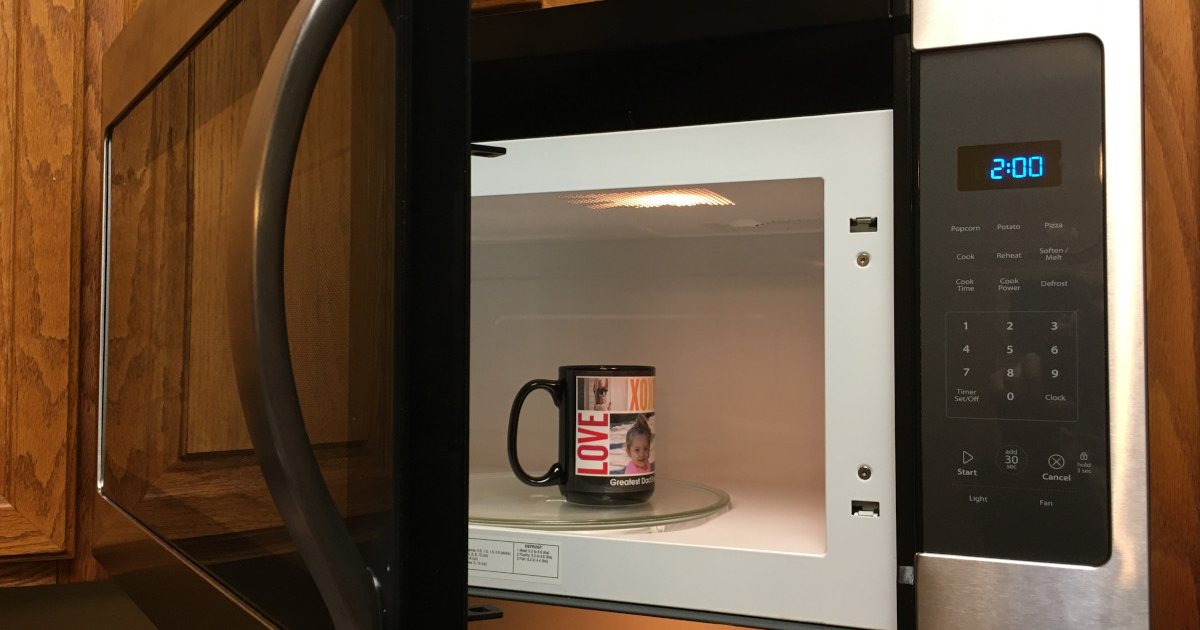
How long do microwaves last? About 9 years on average, according to a study of home component life expectancy by the National Association of Home Builders. How long yours lasts depends on how often it runs, how clean it’s kept and what kind it is.
Age alone doesn’t decide whether to replace it. A built-in or over-the-range model under 8 to 10 years old with one small fault is usually worth fixing, and our technicians handle that kind of microwave repair in Calgary. An older countertop microwave with a dead magnetron or a bent door is usually better replaced.
Key Takeaways
- A 2007 National Association of Home Builders study puts the average life of a microwave oven at 9 years.
- Health Canada says not to use a microwave whose door “does not close, or is bent, warped or damaged in any way,” and to hire qualified technicians for all repairs.
- Repair usually makes sense when the microwave is under about 8 to 10 years old and the repair costs less than half the price of a comparable new one. That favours over-the-range and built-in models, which cost more to replace and install.
How long do microwaves last?
The NAHB and Bank of America Home Equity Study of Life Expectancy of Home Components (February 2007) lists microwave ovens at 9 years. The study notes that life depends on maintenance and how hard an appliance is used, so treat 9 years as an average. Yours may fall short of it or outlast it.
Countertop, over-the-range and built-in microwaves
The study gives one figure for how long microwaves last, whatever the type. Type matters more for the repair decision than for lifespan. An over-the-range microwave is a model that hangs under a cabinet on a wall plate and often vents the cooktop below. A built-in sits in a cabinet opening with a trim kit. Replacing either means buying a unit that fits the same space and paying to install it, while a countertop microwave just unplugs and goes. If you’re unsure which kind you have, our countertop vs. over-the-range comparison explains the difference.
What shortens a microwave’s lifespan
- Heavy use. A microwave that runs many times a day wears its parts faster, which is the use factor the NAHB study points to.
- Overheating. GE says a microwave can shut off from overheating after long cooking times or when its vents are blocked.
- Dirt and splatter. Food left on the waveguide cover can burn and spark, and Health Canada says leakage can increase with “a build-up of dirt around the seal.”
- Door wear. The door and its switches open and close thousands of times. A slammed or bent door damages the latch and the safety switches behind it.
Signs your microwave is near the end of its life
Watch for these signs that a microwave is going bad:
- food takes longer than it used to, or comes out cold in the middle
- loud buzzing, humming or grinding noises
- sparks or flashes with nothing metal inside
- a burning smell that doesn’t come from the food
- a door that won’t latch, or a microwave that runs with the door open
- a tripped breaker every time you start it
To check the heating, Maytag suggests putting one cup (250 mL) of water on the turntable and running it for 1 minute on HI. If the water warms, the microwave is heating. Plug it straight into a wall outlet first, and make sure Control Lock and demo mode are off. If the water stays cold, see our guide to a microwave not heating food.
Is it worth repairing a microwave? Repair or replace by age
Knowing how long microwaves last is only part of the decision. Weigh four things: the type of microwave, its age, what failed, and the repair quote against the price of a new unit. Our rates page gives a simple rule: repair when the appliance is under about 8 to 10 years old and the repair costs less than half the price of a comparable new one.
| Situation | Usual call |
|---|---|
| Door switch, fuse or turntable motor on a newer unit | Repair |
| Over-the-range or built-in model with a minor fault | Repair |
| Magnetron or control board on a countertop unit near or past 9 years old | Replace |
| Parts no longer made for the model | Replace |
| Bent door frame, or rust inside the cavity | Replace |
| Repeated malfunctions in a short time | Replace |
What usually fails on a microwave
- Magnetron, high-voltage diode and capacitor. The magnetron is the tube that produces the microwaves, and the diode and capacitor feed it high voltage. If one fails, the light and fan run but food stays cold. Our guide to magnetron failure and other no-heat causes covers this.
- Door switches and fuses. A door interlock is a switch that cuts power to the heating circuit when the door opens. When one fails, the unit may not start, or it may blow its fuse and go completely dead.
- Turntable motor or coupler. The plate stops turning and food heats unevenly.
- Keypad and control board. Buttons stop responding, or the display goes blank or shows errors.
- Waveguide cover. The waveguide cover is the small panel on the inside wall that covers the opening microwaves enter through. It can get soaked with splatter and burn, which causes sparks.
On Calgary service calls, the most common microwave fault is a unit that runs but won’t heat, usually a burnt-out magnetron. On older Panasonic inverter models, our technicians sometimes find the magnetron or inverter board is no longer made, and then replacement is the only option. Dead microwaves come next: on built-in units, a failed door switch has usually blown the fuse, so we replace the switches and the fuse together.
What microwave repair costs in Calgary
Our rates page shows what appliance repair costs. Typical microwave repairs run $160 to $400 all-in, which covers the diagnostic, parts and labour, before GST. The diagnostic is a flat $100, credited toward labour if you go ahead, and you get a quote before any work starts. Parts are listed on that quote.
Two things move the number. An over-the-range repair usually means taking the microwave off the wall and reinstalling it above the stove afterwards. And for an inexpensive countertop unit, parts and labour can cost more than a replacement. Our technicians will tell you when that’s the case, so the $100 diagnostic is all you pay.
When to replace your microwave
- The door is bent, warped or won’t close. Health Canada says not to use a microwave whose door “does not close, or is bent, warped or damaged in any way.” The FDA adds that “a damaged microwave oven may present a risk of microwave energy leaks.” Stop using it until a technician has checked it.
- The inside is rusted or burned through. A waveguide cover is a cheap part to swap. Rust or burn damage in the cavity walls usually isn’t worth fixing.
- It’s an older countertop model with a major fault. Money spent on a magnetron or control board for a unit near or past 9 years old is usually better spent on a new one.
- The malfunctions keep coming. A second or third repair in a short time suggests other parts are wearing out too.
Why microwave repair needs a professional
Panasonic’s service manual calls a microwave “a high voltage, high current device” and says the document is meant “for experienced repair technicians only.” Its steps include discharging the high-voltage capacitors before work starts, because unplugging alone doesn’t make the inside safe. The manual also warns that leakage can exceed the 5 mW/cm² limit if the door hinges or magnetron are fitted wrongly, which is why technicians check for leakage after a repair.
What you can do safely: check the breaker and outlet, run the water test, reseat the turntable and wipe the door seal. Our guide to a microwave not working covers more owner-level checks.
How to make your microwave last longer
- Wipe up splatter after use, especially on the waveguide cover and around the door seal. Our microwave cleaning guide has the steam method.
- Keep the vents clear and leave the space the manual asks for around a countertop model.
- On an over-the-range model, clean the grease filters monthly and replace the charcoal filter on the maker’s schedule.
- Close the door gently, and don’t use a microwave whose door doesn’t shut firmly.
- Plug it straight into a wall outlet, not an extension cord or power strip.
How long do microwaves last: common questions
Is it worth repairing a 7-year-old microwave? Often, yes. Seven years is inside the 8-to-10-year window, so if the quote is under half the price of a comparable new unit, repair it. That’s especially true for an over-the-range or built-in model.
Is it worth repairing a microwave that’s over 10 years old? For a countertop model, rarely. For a built-in or over-the-range unit with a minor fault, such as a door switch or fuse, it can still be worth it, because replacing it also means paying for installation.
How long does it take to replace a microwave? A countertop model takes minutes: unplug it and set the new one in place. An over-the-range or built-in model takes longer, because it has to come off its wall plate or out of its cabinet opening, and the new one must fit the same space and venting.
Are 20-year-old microwaves safe? Age alone doesn’t make one unsafe. The FDA says “microwave energy will not leak from a microwave in good condition.” What matters is the door, hinges, latch and seals. If any of them is damaged, or the door doesn’t close firmly, stop using it. A 20-year-old unit is well past the 9-year average, so parts may be hard to find if it breaks.
What is the most common microwave failure? On our Calgary service calls, a microwave that runs but doesn’t heat, usually from a failed magnetron. Door switch and fuse failures that leave the unit dead come next.
When should you throw away your microwave? When the door is damaged, the cavity is rusted through, or a major repair costs more than half the price of a new one. Take it to an electronics or appliance recycling drop-off rather than putting it out with the household garbage.
What is the most reliable built-in microwave brand? There’s no free, independent reliability ranking we can point you to. Before you buy, check how long the warranty runs and whether parts and service for that brand are easy to get in Canada.
Photo: Open microwave with mug inside by Dean DiSalvo, CC BY-SA 2.0. Cropped.