
If you’re working out how to clean dryer vent ducts safely, start by unplugging the dryer and pulling it out. Clean the lint screen and the slot it sits in, then brush and vacuum the hose and the wall duct. Finish by clearing the exterior vent hood and checking that air blows out strongly.
A short, straight run is a fair DIY job. Long runs and stacked units in closets are harder, and they come up often on our visits for dryer repair in Calgary.
Key Takeaways
- The NFPA says the leading cause of home clothes dryer fires is failure to clean them.
- Clean the lint filter every load and the vent pipe once a year, or sooner if drying slows down (NFPA).
- Use metal duct. Electrolux’s installation instructions say not to use flexible plastic or flexible foil venting.
- Leave long runs, roof or attic vents and stacked closet units to a technician.
How to tell if a dryer vent is clogged
Drying time is the clearest sign. If a normal load needs two cycles, or the dryer stops partway through, check the vent before you blame the dryer. On Calgary service calls, a dryer that shuts down mid-cycle is very often protecting itself from a blocked vent.
Other signs of a clogged dryer vent:
- The top and sides of the dryer feel hot, and the laundry room gets warm and humid.
- You smell something scorched while the dryer runs.
- The outdoor flap barely opens, or the air coming out feels weak.
- Lint and dust collect behind the dryer or around the exterior hood.
- An LG dryer shows d80, d90 or d95. LG Canada lists these as 80%, 90% and 95% exhaust blockage.
One exception: on many newer Electrolux dryers, slightly damp clothes are the Eco setting doing its job. Time Dry or Dry Boost finishes the load.
How to clean dryer vent ducts step by step
- Unplug the dryer and pull it out.
- Clean the lint trap and its housing.
- Disconnect and clean the transition hose.
- Brush the wall duct from inside.
- Clean the exterior vent hood.
- Reconnect, seal and test.
Before cleaning, get a nut driver for the clamps, a dryer vent cleaning kit with flexible rods, a vacuum with a hose attachment, metal foil tape and gloves.
Step 1: Unplug the dryer and pull it out
Unplug the dryer or switch off its breaker. Slide a gas dryer out slowly so the gas connector isn’t strained. The NFPA clothes dryer safety tip sheet says a qualified professional should check that a gas line and connection are “intact and free of leaks,” so leave the gas connector to a pro.
Step 2: Clean the lint trap and its housing
Clear the screen, then vacuum the slot below it with a narrow nozzle. The NFPA says to clean the lint filter before or after each load and to remove lint that has collected around the drum. Our dryer lint screen guide covers washing a clogged screen.
Step 3: Disconnect and clean the transition hose
Loosen the clamps and pull the short hose off the dryer and the wall. Shake it out over a garbage bag, run the brush through and vacuum both ends.
Replace it if it’s white vinyl, thin foil or crushed. The installation instructions for Electrolux front-load dryers say not to use flexible plastic or foil venting, because flexible materials “are known to collapse, be easily crushed and trap lint.” With semi-rigid metal, they limit the total duct length to 8 ft (2.4 m).
Step 4: Brush the wall duct from inside
Feed the brush into the wall duct, adding rods as you go. Pull it back every few feet and vacuum out the lint. If it jams, stop. Forcing it can push a plug deeper or separate a joint inside the wall.
Step 5: Clean the exterior vent hood
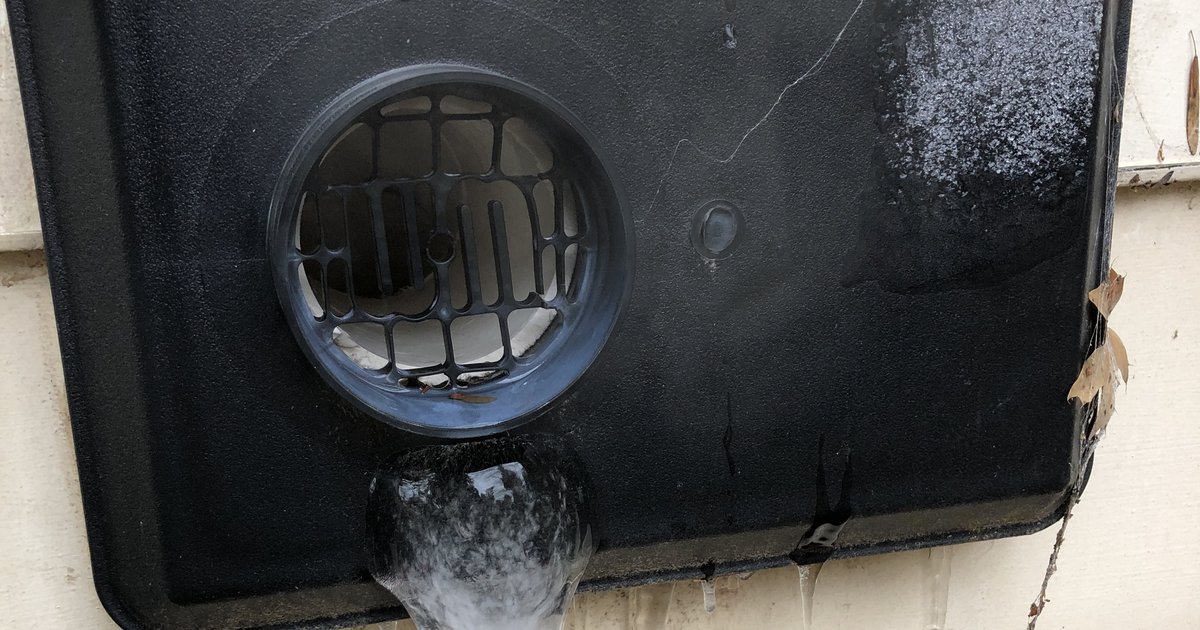
Outside, clear lint and debris from the flap and opening, brush back into the duct if you can reach, and check that the flap swings freely. The same Electrolux instructions say no screen or grate of any mesh size should cover the exhaust opening.
In a Calgary winter, look for snow and frost on the hood too. The NFPA says to check that the outdoor vent flap isn’t covered by snow. Health Canada says to keep the outside vent “clear of obstructions, such as snow and foliage.”
Step 6: Reconnect, seal and test
Refit the hose, tighten the clamps and seal the joints with metal foil tape. Skip screws: fasteners that reach into the duct catch lint, as LG’s dryer manual notes. Ease the dryer back without crushing the hose. Run a short cycle and check for strong airflow at the exterior hood.
How often to clean a dryer vent, and why it matters
Deep clean the whole vent once a year. The NFPA puts it this way: “Once a year, or more often if you notice that it is taking longer than normal for your clothes to dry, clean lint out of the vent pipe or have a dryer lint removal service do it for you.” Electrolux’s instructions call for a full inspection and cleaning at least every 18 months with normal use.
The NFPA says the leading cause of home clothes dryer fires is failure to clean them. Health Canada adds that “leftover lint in the screen and exhaust piping of clothes dryers can ignite in high temperatures and cause fires.”
- Every load: clean the lint trap.
- Routinely: inspect the outside vent and remove built-up lint, as Health Canada advises. Clear snow after a storm.
- Once a year: do a full dryer vent cleaning: hose, wall duct and exterior hood.
When the vent is too long or too high to clean yourself
A home cleaning kit reaches the first stretch of duct. This table sums up where DIY ends.
| Vent setup | DIY? | Why |
|---|---|---|
| Short, straight run to an outside wall | Yes | A brush kit reaches the whole duct |
| Long run or several elbows | Technician | Lint builds up at every bend |
| Roof or attic vent | Technician | Ladder work, and lint falls back down |
| Stacked pair in a closet | Technician | Units may need unstacking |
Long vent runs in newer homes
On our Calgary dryer calls since mid-2025, we’ve regularly found long, complicated vent runs in newer homes. Those Electrolux instructions allow no more than four 90° elbows in a system. Clearing or shortening those runs restored normal drying.
Roof vents, attic runs and sealed outlets
A roof vent means a ladder and a pitched roof, and loosened lint falls back down the duct. We’ve found a duct routed up into an attic, and an outdoor outlet that was still sealed from installation.
Stacked units in tight closets
On many of our Calgary dryer calls, the pair is stacked in a closet. Reaching the duct often means unstacking them, and the duct is easily crushed when they’re pushed back.
For any of these, book a dryer vent cleaning: $150 for each 10 ft of duct, covering the inner duct plus the outer section and exit port where reachable. Unstacking adds $50. If the vent is clear and the dryer still won’t heat, a $100 diagnostic finds the fault and is credited toward labour if you go ahead.
Dryer vent cleaning questions
Can I clean my dryer vent myself? Yes, if the duct is short and you can reach both ends. Call a technician for long runs or several elbows, roof or attic vents, and stacked units in closets.
Is it better to clean the dryer vent from the inside or outside? Do both. Start inside, where lint usually collects first, and finish at the exterior hood. Disconnect the dryer first so lint pushed back from outside doesn’t end up in the machine.
Can I use a leaf blower to clean a dryer vent? Only on a short, straight run with the hose off. Air alone won’t remove lint stuck to the duct walls, and on a long run it can loosen a taped joint inside a wall. Brush first.
What do professionals use to clean dryer vents? Dryer vent cleaning crews generally use a rotating brush on long flexible rods, driven by a drill, with a strong vacuum at the open end. Ask for an airflow check at the outdoor hood when they finish.
Need help with a long or hard-to-reach dryer vent in your home? Book online or call 587-816-2400 for a same-day or next-day appointment in Calgary and surrounding towns.
Photo: An icicle on a clothing dryer vent during a severe cold snap by Famartin, CC BY-SA 4.0. Cropped.