
The best built-in range hood for most kitchens is a ducted insert that is at least as wide as your cooktop and carries an HVI Certified airflow rating. Size it with the Home Ventilating Institute's figure of 100 CFM per linear foot of range width for a hood against a wall. That works out to about 250 CFM for a 30-inch range and 300 CFM for a 36-inch range.
A built-in hood (some sellers call it a cooker hood) hides the fan inside a kitchen cabinet or custom enclosure, so the kitchen keeps a clean, sleek look. For most homes, choosing the best built-in range hood depends less on the brand than on the fit, the airflow and where the duct goes, especially in an older kitchen with an existing duct. If you're only shopping because the old fan quit, you can book a range hood repair and get a quote first.
Key Takeaways
- HVI recommends 100 CFM per linear foot of range for a hood against a wall and 150 CFM per foot for an island.
- Health Canada says running the range hood on high can cut exposure to cooking pollutants by more than 80% compared with slower speeds.
- Consumer Reports says to pick a hood at least as wide as the cooking surface, and it generally doesn't recommend ductless hoods.
- Check the spec sheet for two airflow numbers. Hauslane lists its IN-R100 insert at 600 CFM "equivalent" airflow but 450 CFM "laboratory" airflow.
What counts as a built-in range hood?
A built-in range hood is a fan and filter unit made to sit inside kitchen cabinetry, a wood or plaster hood shell, or a custom enclosure above the stove. You see only the bottom of it: the filters, lights and controls. The cabinets around it set the look of the kitchen. Here's how it compares with the other common range hood styles.
Insert (liner) range hoods
An insert, also sold as a liner or power pack, drops into an opening that your cabinet maker or contractor builds. It's the usual choice when you want the range hood to match the cabinet doors or a kitchen design with a plaster or wood canopy. The enclosure has to be built to the insert's spec sheet, so pick the unit before the cabinet is made.
Under-cabinet range hoods
An under-cabinet hood screws to the bottom of the wall cabinet above the range. It's visible, but an under-cabinet range hood is usually cheaper and easier to swap than an insert, and you can often replace an older one with no carpentry at all.
Wall chimney and island hoods
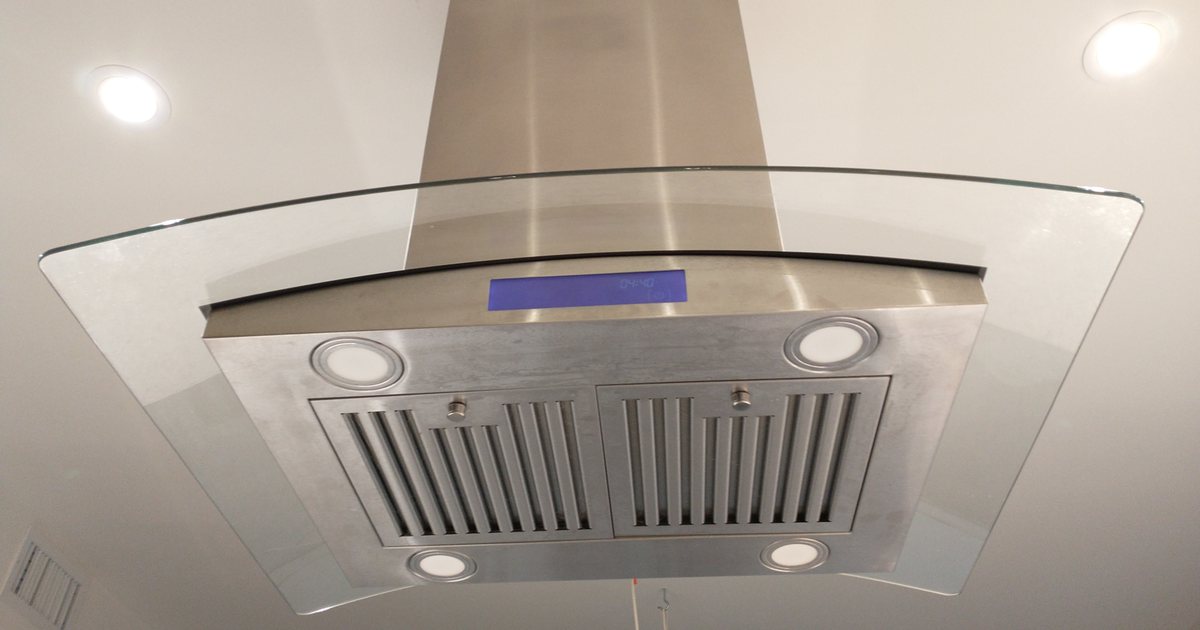
A wall chimney hood is for a stove with no cabinet above it, and an island hood hangs from the ceiling and vents through ductwork there. Both are on display in the kitchen, so they're chosen as much for design as for performance. The photo above shows an island-style hood with stainless steel baffle filters.
Over-the-range microwaves and downdraft vents
An over-the-range microwave doubles as a range hood and saves cabinet space in a small kitchen. See our countertop vs over the range microwave guide for the trade-offs. Downdraft vents pull air across the cooktop and down, and Consumer Reports says its tests found them "among the least effective at removing smoke and steam."
Are range hoods effective?
Yes, when they're ducted outside, sized to the cooktop and switched on. Health Canada's factsheet on cooking and indoor air quality says cooking on any stove, gas or electric, creates fine particles from food, fat and oil. One Health Canada study found particle levels "65 times higher than background levels following cooking activities." Gas stoves also give off nitrogen dioxide, and cooking adds a lot of water vapor to kitchen air.
The same factsheet says to use the range hood "preferably on the high setting," which can reduce exposure "by more than 80% when compared to slower speeds." It also recommends a hood that fully extends over the burners and cooking on the back burners when you can.
The Home Ventilating Institute, a non-profit group of ventilation manufacturers from Canada, the US, Asia and Europe, adds that a hood should "capture and vent" heat, odors, grease, steam and smoke and send them outside the home. A hood that only recirculates air through a filter can trap grease and some odors, but it doesn't exhaust anything outside, so steam and combustion gases stay in the kitchen.
How to choose the best built-in range hood
Six things decide which is the best built-in range hood for your kitchen. Go through them in this order, because the first three limit the rest.
1. Width: as wide as the cooktop or wider
Consumer Reports' range hood buying guide says to "select a model that's at least as wide as the cooking surface underneath," and wider still for an island. HVI's consumer guide says hood width "should match the cooking range."
With inserts, watch the difference between the nominal size and the actual body. Hauslane's 30-inch IN-R100 measures 29 3/8 inches wide, which leaves room for the enclosure around it. If you cook a lot of stir-fries or seared meat, a range hood one size up can give better coverage.
2. CFM: size it with HVI's numbers
CFM (cubic feet per minute) is how much air the range hood fan moves out of the kitchen. HVI's range hood guide gives these rates for a hood against a wall:
| Hood width (against a wall) | HVI recommended rate | HVI minimum |
|---|---|---|
| 30 in. (2.5 ft) | 250 CFM | 100 CFM |
| 36 in. (3 ft) | 300 CFM | 120 CFM |
| 48 in. (4 ft) | 400 CFM | 160 CFM |
More isn't automatically better. Consumer Reports says more airflow "doesn't guarantee better smoke capture," and that many hoods with modest claimed airflow vented as well as hoods claiming twice as much. If you're looking at a very large fan, ask your installer whether your home needs make-up air for it. Make-up air is outside air brought into the house to replace the air the hood pushes out.
HVI also warns that "there are no government standards for rating range hood performance," so look for the HVI Certified label. The Hauslane IN-R100 spec sheet shows why: it lists 600 CFM "equivalent airflow" and 450 CFM "laboratory airflow." Compare hoods on the same kind of number.
3. Ducted, ductless or convertible
A ducted hood sends air outside through a wall or roof cap. A ductless hood runs air through a charcoal filter and blows it back into the kitchen. Consumer Reports says, "We generally don't recommend ductless hoods because they don't actually exhaust contaminants outside."
Many inserts, including all of Hauslane's Canadian built-in models, are convertible, meaning they can run either way. The Hauslane IN-R100 runs ducted through a 6-inch round duct, or ductless with charcoal filters that are sold separately. Budget for charcoal filter replacement if you go ductless, because those filters can't be washed. Convertible is useful in a condo where you can't cut an exterior wall, but ductless hoods leave steam and gases in the kitchen, so vent outside if you have the choice.
4. Noise in sones
Range hood noise is rated in sones. HVI explains that doubling the sone number sounds about twice as loud to the human ear. Check the sones on both the high and low speeds: Health Canada recommends cooking on high, and Consumer Reports suggests leaving a hood on a very low speed after cooking to keep clearing the air.
HVI says the sound comes from the air entering the hood, the fan and the ductwork, so it recommends a low sone rating and a properly sized, properly installed duct. A kinked duct makes any range hood louder and less able to remove smoke.
5. Grease filters and cleaning
Built-in range hoods use either mesh filters or stainless steel baffle filters. A baffle filter is a panel of angled metal channels that makes the air change direction, so grease drops out; a mesh filter is layers of fine aluminum screen. Hauslane says the IN-R100's stainless steel baffle filters "catch grease before they drip," and they go in the dishwasher. Clean them as often as your manual says, and more often if you fry a lot. A clogged filter is a common reason for a hood fan not venting properly, and our guide to cleaning range hood filters walks through it.
6. Lights and controls
Consumer Reports treats lighting as one of the things that separates one range hood from another, and you need good light on the cooktop. LED lights with a standard replaceable bulb are easy to keep working; the IN-R100 uses GU10 bulbs. Simple push buttons on the front edge are easier to reach on a recessed insert than controls tucked underneath.
Best built-in range hood options sold in Canada
We repair appliances; we don't sell range hoods and we haven't lab-tested these models. The specs below come straight from each manufacturer, to show what the numbers look like and what to compare.
| Spec | Hauslane IN-R100 | Broan PM300SS |
|---|---|---|
| Type | Built-in insert, convertible | Power pack insert for a custom hood |
| Widths | 30 in. and 36 in. | 21 in. body |
| Airflow | 600 CFM equivalent, 450 CFM laboratory | 300 CFM max blower, HVI Certified |
| Noise | 1.5 to 7.0 sones | 3 sones on normal speed |
| Duct | 6 in. round | 7 in. round |
| Filters | Stainless steel baffle, dishwasher-safe | Dishwasher-safe |
Hauslane IN-R100, IN-R110, IN-R200 and IN-R300
Hauslane's Canadian built-in range hoods are all stainless steel convertible inserts with a recessed design. The IN-R100 and the Canada-specific IN-R110 are 11 1/4 inches deep in 30- and 36-inch widths. The IN-R200 is 18.5 inches deep (30, 36 and 42 inches) and the IN-R300 is 21 inches deep (34, 40 and 46 inches), for deeper hood shells.
The IN-R100 has three fan speeds, plugs into a 120-volt outlet, and comes with a 2-year limited warranty plus a lifetime warranty on the motor. Hauslane is one of the brands named in Consumer Reports' range hood guide.
Broan PM300SS power pack
Broan-NuTone's PM300SS is a 21-inch power pack made to sit inside a wood or plaster hood built by your cabinet maker. Broan lists it as HVI Certified at 300 CFM and 3 sones on normal speed. That meets HVI's recommended rate for a 30- or 36-inch range against a wall.
Other brands worth a look
Venmar is a Canadian ventilation company based in Drummondville, Quebec. Zephyr, also named in Consumer Reports' guide, sells range hood inserts too. The guide also names Broan-NuTone, Frigidaire, GE, Viking, Vent-A-Hood, Whirlpool and Wolf. For any of them, check that the exact model is HVI Certified and that parts are easy to get in Canada.
What we see on Calgary repair calls
On Calgary service calls, the most common range hood repair is a seized fan motor on an insert hood, mostly Faber and similar units. On recent Calgary jobs (November 2025 to October 2026), that repair came to about $930 to $1,135 all-in, including the diagnostic fee, which was $135 until August 2026 and is now $100. Our technicians also see older hoods that have to be replaced because the brand no longer makes parts for them.
Before you buy, look at the motor warranty and ask the seller how long the brand stocks motors and light parts in Canada. A lifetime motor warranty like Hauslane's is worth more on an insert than on a cheap under-cabinet hood, because the insert is built into the cabinetry.
Installing a built-in range hood in a Calgary home
Even the best built-in range hood will disappoint if it's badly ducted. HVI says a duct's efficiency depends on "its width, number of bends, and length," so plan the shortest straight run you can to the outside.
- Match the duct to the hood. Don't neck a 7-inch outlet down to an old 5-inch or 6-inch duct.
- Use a wall or roof cap with a working damper. A damper is the flap that opens when the fan runs and closes to block backdraft. In a Calgary winter, a flap that sticks open lets cold air and frost back into the duct. Our technicians have traced a cold draft at the hood to an exterior cap that was left without its closing flap after siding work.
- Build the cabinet to the spec sheet. Check the cut-out size, depth and power location before the enclosure is made.
- Follow the mounting height in the manual. HVI says to place the hood at the height the manufacturer recommends above the cooking surface.
- Plan the power. Some inserts plug in and some are hardwired, which may need an electrician.
Grease build-up inside a range hood is also a kitchen fire risk, so keep filters clean and read our oven safety tips. If your existing range hood fan is weak, noisy or dead, our range hood repair team can check the motor, switches and lights before you replace it.
Range hood questions people ask
What is the best stove hood? The best range hood is the one that captures the smoke from your cooktop: ducted outside, at least as wide as the stove, HVI Certified, and sized to HVI's 100 CFM per linear foot of range for a wall hood. If you want it hidden in the kitchen cabinets, the best built-in range hood for you is an insert that meets those same numbers.
Are range hoods effective? Yes. Health Canada says using one on high can cut exposure to cooking pollutants by more than 80% compared with slower speeds. A ducted range hood works better than a ductless one because it moves the air, grease and odors outside.
Which brand of cooker hood is considered the best? We didn't find an independent ranking of range hood brands as a whole, and many brands sell both basic and premium lines. Consumer Reports rates individual models. Compare certified CFM, sones, width and filters on the exact model.
What is the best brand of rangehood? The best built-in range hood brand is the one that makes a certified model in your size with parts and service you can get locally. Broan-NuTone and Hauslane both sell built-in inserts in Canada.
What is the best range hood brand in Canada? There's no official Canadian ranking. Venmar is a Canadian company, Broan-NuTone runs a Canadian site, and Hauslane sells a Canada-specific insert, the IN-R110.
What is the best range hood according to Consumer Reports? Consumer Reports' model-by-model ratings are for paying members and change as it tests new hoods. Its free guide says "the best hoods in our ratings excel at containing and exhausting smoke and fumes and exchanging air." It favors ducted hoods and rates downdraft vents among the least effective.
Photo: California Kitchen Range Hood by Stilfehler, CC BY-SA 4.0. Cropped.