
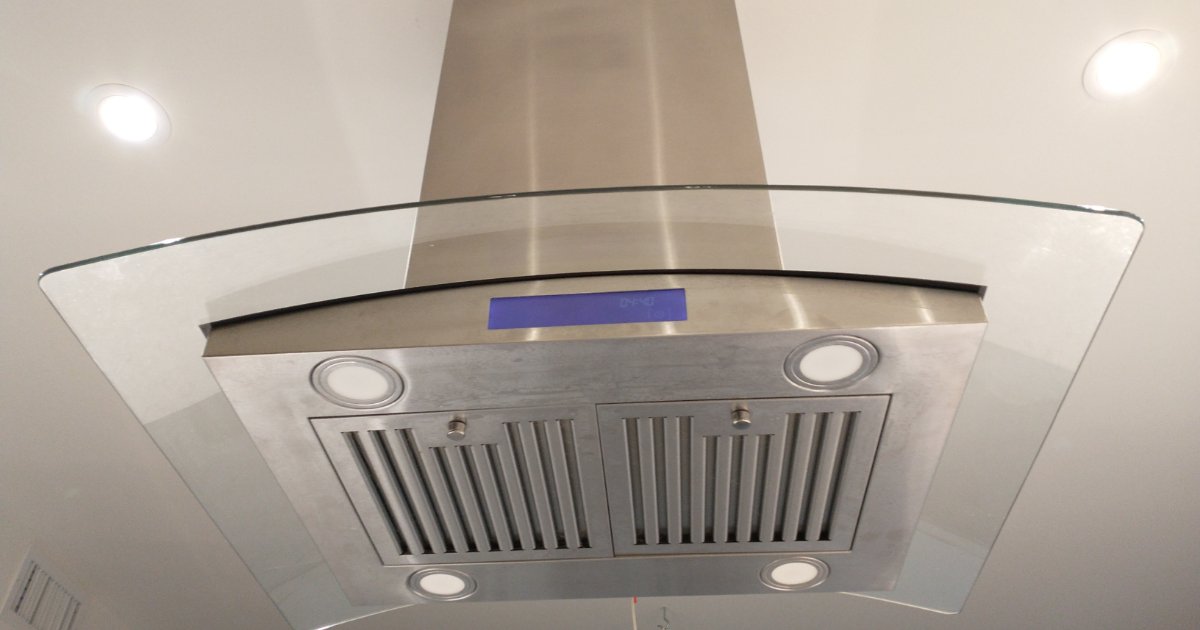
A range hood not pulling air is usually a restriction problem. GE Appliances puts it plainly: exhaust performance depends on many factors, "the most important being anything that restricts airflow."
That restriction can be a greasy filter, a worn-out charcoal filter, a damper that won't open, a long or crushed duct, or a house so airtight the fan can't pull against it. Sometimes the hood was never big enough for the cooktop under it. You can check most of these yourself. A fan that hums, grinds or won't spin at all is a job for range hood repair in Calgary.
Key Takeaways
- GE says anything that restricts airflow is the biggest factor in how well a hood exhausts. Start with the grease filters.
- Charcoal filters on recirculating hoods can't be washed. Whirlpool says one lasts up to 6 months with normal use.
- KitchenAid's rule of thumb for gas cooking is about 1 CFM of hood capacity for every 100 BTU of cooktop output.
- Whirlpool notes that in a very tight house a hood may not vent properly, because the air it exhausts has to be replaced.
Why is your range hood not pulling air?
Work through these causes in order. The first two are the easiest to check and the cheapest to fix.
1. Clogged grease filters
Metal grease filters catch grease before it reaches the blower, and they fill up over time. A loaded filter blocks air the same way a dirty furnace filter does. GE says to keep filters and hood surfaces "clean of grease and dirt," and Samsung names clogged grease filters as a reason its hoods aren't venting properly.
Look at how the filter sits as well. GE says it should go in with the open end up so it clears the fan blade, and it shouldn't be twisted or bent. Our guide to cleaning baffle and mesh filters covers the washing steps.
2. A spent charcoal filter (recirculating vs ducted hoods)
Find out which kind of range hood you have. KitchenAid explains that a ducted hood pushes air through ductwork to the outside, while a ductless (recirculating) hood filters the air and blows it back into the kitchen. If there's no duct above the hood and air comes out of a vent on the front or top, it's recirculating.
A recirculating hood uses charcoal filters behind the grease filters. A charcoal filter is a pad of activated carbon that absorbs cooking odours before the air is blown back into the room. GE says not to immerse them in water; they have to be replaced. Whirlpool says a charcoal filter "should last up to 6 months with normal use," and KitchenAid also says to replace them every six months.
Set your expectations, too. KitchenAid notes that a ductless hood can't vent smoke out of your home, and that a ducted hood also pushes heat and moisture outside. A recirculating hood that seems weak over a hot pan may simply be working as designed.
3. A stuck damper or blocked wall cap
Ducted hoods have a damper, a flap that opens when the blower runs and closes to stop backdraft, which keeps ventilation one-way. GE's advice is to check the damper cover: "it should swing freely." Old grease can glue it shut, and a bent flap can catch and stop it closing properly.
Then go outside and look at the wall or roof cap while someone runs the range hood on high. The flap should lift. GE says to make sure nothing such as animal nests or packing materials is blocking the vent. In a Calgary winter, a cap flap that sticks open also lets cold air down the duct, so a draft at the hood is a clue. On one Calgary winter call, cold air coming in through the hood turned out to be the exterior vent cap: it had been left without its closing flap after siding work, and nothing was wrong with the hood itself.
4. Long, crushed or undersized duct runs
Every metre of pipe and every elbow adds resistance. The Zephyr installation manual says that when blowers seem weak, check the duct size (at least 6 inches round or 3-1/4 x 10 inches rectangular for those models), reduce the number of elbows and the length of the ductwork, and check that all joints are "properly connected, sealed and taped."
Bosch's support page lists the same duct issues: something blocking the airflow, or ducts that are damaged or disconnected. Zephyr adds that debris from old ductwork can fall into the hood's discharge opening. If you can see the pipe in a cabinet or attic, inspect it for kinks, gaps and loose foil tape.
5. Undersized CFM for your cooking
Some range hoods work properly and are just too small for the job. Hood capacity is rated in cubic feet per minute (CFM). KitchenAid's rule of thumb for a gas cooktop is one CFM for every 100 BTU, and it notes that the rated CFM is the hood's highest speed. A cooktop with 40,000 BTU of burners works out to about 400 CFM by that rule.
GE warns that "low-CFM hoods do not have the draw power needed to eliminate smoke and odors," and that some shouldn't go over high-BTU professional-style ranges. Mounting matters too. Zephyr's manual says the hood should sit at the recommended height and cover the whole cooking surface, and Whirlpool says cabinets closer than the minimum distance can create dead air pockets.
6. No makeup air
A range hood not pulling air in a newer, well-sealed home may be short of makeup air. A hood can only push out as much air as can get back in. Makeup air is the outside air that enters the house to replace what the hood exhausts. Whirlpool says "the air exhausted by the unit must be replaced," that a hood may not vent properly in a very tight room or house, and that local building codes may require a makeup air system above a set CFM.
A quick test: run the hood on high, then open a nearby window a few centimetres. If the draw improves right away, the house is starved for air. Ask a ventilation contractor about makeup air before buying a bigger fan, because a bigger fan needs even more replacement air.
7. A weak motor or damaged fan
If the filters, damper and duct check out, look at the blower. The blower is the motor and fan wheel inside the hood that actually move the air. A motor that hums, runs slower than it used to, or cuts out after a few minutes may be wearing out. A cracked or grease-heavy fan wheel moves less air at the same speed. Motor and fan work means taking the hood apart. Our range hood repair page explains what a technician checks on the visit.
On Calgary service calls, the most common hood repair is a seized fan motor on insert hoods, mostly Faber and similar units. The fan hums or grinds but won't turn. Our technicians confirm the motor is getting its 120 volts before replacing it. Those motors are expensive: on recent Calgary jobs (November 2025 to October 2026), a fan-motor replacement on an insert hood came to about $930 to $1,135 all-in. That total includes the diagnostic fee, which was $135 until August 2026 and is now $100. Most other hood repairs fall in the $150 to $380 range on our rates page.
Older hoods that rattle and barely pull air don't always need parts. Our technicians have found that a full teardown and degrease of the fan and housing, with the fan blade reseated, brings back quiet, proper suction.
| Cause | How to check | Fix |
|---|---|---|
| Clogged grease filters | Grease film or blocked mesh | Wash and reinstall properly |
| Spent charcoal filter | Recirculating hood, filter over about 6 months old | Replace it (charcoal can't be washed) |
| Stuck damper or cap | Flap doesn't swing freely, cap doesn't open | Free or replace the flap, clear the cap |
| Duct problems | Kinks, gaps, loose tape, long runs | Reseal, shorten or straighten the run |
| Undersized CFM | Smoke escapes even with clean filters | Size the hood to the cooktop's BTU |
| No makeup air | Draw improves with a window open | Ask about a makeup air system |
| Weak motor or fan | Humming, slowing, cutting out | Motor or fan repair |
How to fix a range hood not pulling air
Turn off power at the breaker before you remove filters or reach inside the hood. Then:
- Hold a tissue under the range hood on high. If it barely moves, airflow is restricted.
- Clean the grease filters and reinstall them the right way up.
- On a recirculating hood, replace the charcoal filters if they're more than about six months old.
- On a ducted hood, check that the damper swings freely and that the outside cap opens when the fan runs.
- Look at any visible ductwork for kinks, gaps or disconnected joints.
- Do the open-window test for makeup air.
- Listen to the motor. Grinding, humming or a fan that slows down points to the blower.
Range hood not pulling air after all that? The problem is likely inside the blower or the duct where you can't see it. Our Calgary range hood repair service covers motors, fans, switches and damper problems.
Common questions about range hood airflow
How do I reset a range hood fan? Many hoods have no dedicated reset button. Whirlpool's instructions are to switch off the circuit breaker for one minute, switch it back on, and check that the hood runs. Samsung says to cut power at the breaker for several minutes, and that some models also have a button-combination reset listed in the owner's manual.
Why is my exhaust fan not pulling air? Usually the fan is spinning but working against a blockage: a clogged filter, a closed damper, a blocked cap or a crushed duct. If the fan doesn't spin at all, check the breaker and the controls first.
What are the most common reasons a range vent hood fan isn't working? For weak suction, it's dirty filters, worn charcoal filters, a stuck damper and duct problems. For a fan that won't start, it's usually power, the switch or the motor.
What is the average lifespan of a range hood? A 2007 National Association of Home Builders study put range and oven hoods at about 14 years. The study notes that appliance life depends on use, and that appliances are often replaced for style before they wear out.
Are range hoods easy to replace? A same-size swap onto existing ductwork and wiring is manageable for some homeowners. Changing size, switching from recirculating to ducted, or adding a new wall cap is a bigger job. Zephyr's manual says its hoods are meant to be installed by qualified installers and must meet local codes.
What are the best range hoods in Canada? The right hood depends on your kitchen more than the brand. Duct it outside if you can, match the CFM to your cooktop, and make it at least as wide as the cooking surface. Our guide to choosing a range hood insert compares hood styles.
Sources
- GE Appliances: Hood does not remove smoke or odor
- Whirlpool: Vent hood not removing smoke or odor
- Whirlpool: Fan not working, vent hood
- KitchenAid: Ducted vs. ductless range hoods
- Zephyr: Hurricane, Cyclone and Whirlwind series manual (PDF)
- Bosch: Cooker hood not extracting
- Samsung: Range hood FAQs
- NAHB / Bank of America: Study of Life Expectancy of Home Components, 2007 (PDF)
Photo: California Kitchen Range Hood by Stilfehler, CC BY-SA 4.0. Cropped.