
What to look for when buying a refrigerator comes down to fit, door style, capacity and running cost. Get those right and the extras, like an ice maker or a smart screen, are easy to decide on.
This guide walks through what to look for when buying a refrigerator, using figures from manufacturers and Natural Resources Canada. If you're still weighing a repair on your old fridge, read how long refrigerators last first, or book refrigerator repair in Calgary for a quote to compare.
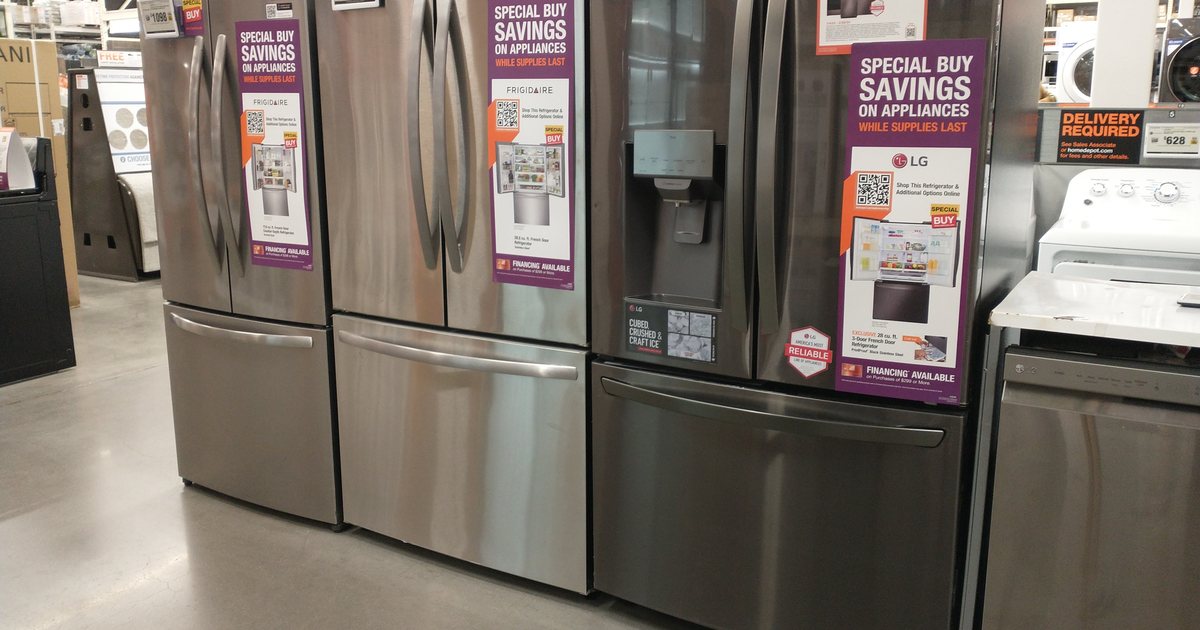
What to look for when buying a refrigerator: will it fit?
Do the measuring at home before you start shopping. Three checks to consider come first:
- The opening: width, height and depth.
- Clearance for air and for the door to swing open.
- The path from your front door to the kitchen.
Measure the opening
Measure the width, height and depth of the space. Check the height under any cabinet above the fridge, and take the width at more than one point, because walls and cabinets are rarely perfectly square. Use the smallest number.
Depth also matters. A counter-depth fridge is one built shallow enough to line up with standard kitchen cabinets. Samsung's refrigerator size guide puts counter-depth models at 28 to 32 inches deep, not counting handles. They sit close to flush with the cabinets, while standard-depth models stick out further.
Leave space for air and the door
A fridge needs a little air around it. The same Samsung guide suggests 2 to 4 inches of clearance on all sides, or at least 3/8 to 1 inch if the space is very tight. Next to a wall, leave 2 to 4 inches on the hinge side so the door can open fully.
Your model's installation guide has the final numbers, so check it before you order.
Measure the way in
Samsung says some buyers have had to return a fridge because it wouldn't fit through the front door, the stairs or a hallway. Measure every doorway and corner between the entrance and the kitchen. If the fridge will be unboxed in the kitchen, check the box size too.
Check the fridge again once it's in place. Many of our first-month calls on newly delivered fridges are doors that need aligning, drawers sitting on the wrong rails or dents from delivery. All three are easier to sort out if you spot them on delivery day.
Which refrigerator style suits your kitchen?
GE Appliances' refrigerator buying tips say the biggest difference between styles is the door opening space. The door layout also changes who can reach what, which matters when you compare French door and side-by-side models. GE points out that some layouts are easier for children and people in wheelchairs to use.
Top freezer
The freezer sits above the fresh-food section, behind its own door. It's the plain, traditional layout, and ENERGY STAR says models with the freezer on top tend to use the least energy compared with bottom-freezer and side-by-side models.
Bottom freezer
Fresh food is on top at eye level, and the freezer is a pull-out drawer or a door at the bottom. You bend down for frozen food instead of the vegetables you reach for every day.
French door
A French door fridge has two half-width doors over a bottom freezer drawer. Each door is narrower than a single full door, so it needs less room to swing open. Samsung lists its standard French door models at 36 inches wide, and a full-size one at about 70 inches tall and 36 inches deep.
Side-by-side
The fridge and freezer run the full height of the cabinet, side by side. Samsung's standard side-by-side models are also 36 inches wide. The narrow doors need less room to swing, but the freezer compartment is tall and narrow, so check that wide items like a sheet pan will fit.
| Style | Layout | Worth knowing |
|---|---|---|
| Top freezer | Freezer above, fridge below | Tends to use the least energy (ENERGY STAR) |
| Bottom freezer | Fridge above, freezer below | Fresh food at eye level |
| French door | Two fridge doors over a freezer drawer | Smaller door swing; Samsung's standard models are 36 inches wide |
| Side-by-side | Full-height fridge and freezer next to each other | Narrow doors; tall, narrow freezer compartment |
How much capacity does your household need?
Cubic feet per person
Samsung suggests 4 to 6 cubic feet of fridge space per person. Its size chart works out like this:
- 1 to 2 people: 10 to 14 cu. ft.
- 3 to 4 people: 15 to 20 cu. ft.
- 5 or more people: 21 cu. ft. and up
GE puts the number higher: it says a typical family of four is likely to be fine with 25 cubic feet or more. If you shop in bulk or already have a second fridge in the garage, your number will be different, so treat these as starting points.
Look at the layout inside
Capacity alone doesn't tell you how a fridge is laid out. GE suggests opening the doors in the store to see whether the shelves can be moved, taken out or slid back. Bring the height of your tallest jug or bottle with you.
Energy use and running cost
A fridge runs around the clock for years, so compare running cost as well as the price tag.
Read the EnerGuide label
The EnerGuide label is the energy label you'll see on new fridges sold in Canada. Natural Resources Canada says the EnerGuide label shows the model's yearly energy use in kilowatt hours. It also shows where the model sits between the most and least efficient models in its class, and the type and size of models in that class. The lower the number, the more efficient the model.
To estimate a yearly cost, multiply the kWh figure by the energy rate on your electricity bill. Compare models of the same type and size, since a larger fridge usually shows a higher number.
ENERGY STAR and Most Efficient models
NRCan's ENERGY STAR refrigerator page says a certified fridge uses 9% less energy, on average, than a standard model. Models with the ENERGY STAR Most Efficient designation are what NRCan calls "the best of the best."
NRCan also says an old refrigerator uses about 35% more energy, on average, than an ENERGY STAR model. It recommends recycling the old one instead of moving it to the basement or garage.
Size and design change the bill
ENERGY STAR says that, generally, the larger the refrigerator, the more energy it uses, and that the most efficient models are typically 16 to 20 cubic feet. A fridge bigger than you'll fill adds to the bill every month.
Features worth paying for
Extra features add to the price and give the fridge more parts that may need service later. Choose the features you'll use every week and skip the rest.
Ice maker and water dispenser
GE says to check for a water line before you choose a fridge with dispenser features. A tall dispenser opening makes it easier to fill pitchers and bottles, and an ice maker inside the freezer takes up less door space than one built into the door.
Filters are an ongoing cost. Samsung's Canadian water filter guide recommends replacing the filter every 6 months and warns that non-Samsung filters "may not fit properly, could leak, and may even damage your refrigerator." On Calgary service calls, a French-door dispenser that keeps dripping after you let go of the paddle usually comes down to a loose or kinked water line inside the door or behind the filter housing. If an ice maker stops working, see our guide to a refrigerator ice maker not working.
Smart features
Smart models connect to a phone app over Wi-Fi. Smart features vary a lot between brands and models, so read the features list for the exact model number before you pay extra for it.
Finish
Check which finish options the model comes in, and pick a finish that matches your other appliances. If you want the fridge to match your cabinets instead, ask whether a panel-ready version exists. A panel-ready fridge is one sold without door fronts so a cabinet maker can fit panels that match the kitchen. Look at the finish under the store lights before you buy.
Questions about what to look for when buying a refrigerator
What to look for in a new refrigerator? Here is what to look for when buying a refrigerator, in order: a fit with the right clearances, a door style that works in your kitchen, the capacity your household needs, and a low kWh figure on the EnerGuide label. Then add only the features you'll use.
What month is the cheapest to buy a fridge? We couldn't find reliable Canadian price data that points to one month. Pick a model number, track its price at a few retailers for a few weeks, and ask whether a floor model or an outgoing model is available.
Do you have to wait 24 hours before using a new fridge? Not always. Samsung's support guidance says to let the fridge stand for 2 to 3 hours after installation before turning it on and loading food. Check your own model's manual for its wait time and the temperature setting to start with.
What is the average lifespan of a Samsung refrigerator? Samsung doesn't publish one on its warranty page. Its US refrigerator warranty page lists 1 year of parts and labour on the whole fridge, 5 years on the sealed system and 10 years of parts on the digital inverter compressor. Check the Canadian warranty card for your model.
What refrigerator brand to stay away from? We don't know of any public data good enough to name one. Compare the warranty, check that parts are sold in Canada, and make sure someone local services the brand.
What is the best refrigerator in 2026? No source we checked names one model as best for every home. For energy use, the ENERGY STAR Most Efficient models on NRCan's list are a good shortlist.
A good door seal keeps a new fridge running efficiently. Here's how to tell if a refrigerator door seal is bad. If your current fridge just needs a fix, book refrigerator repair in Calgary.
Photo: Large Household Appliances in a Home Improvement Store in California, in 2024 (02) by Stilfehler, CC BY-SA 4.0. Cropped.