
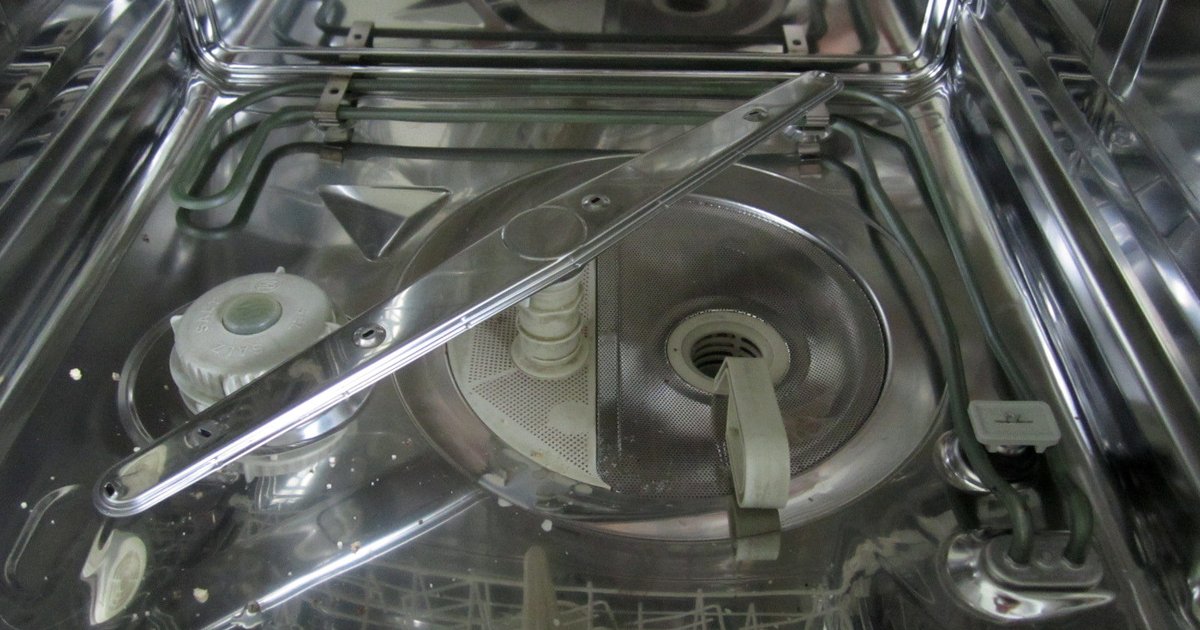
Here's how to clean a dishwasher: take out the filter and wash it, clear the spray arm holes, wipe the door seal and the bottom edge of the door, then run an empty hot cycle with white vinegar or a dishwasher cleaner. Plan on about 20 minutes of hands-on work plus one wash cycle.
Do this deep clean when the dishwasher smells, dishes come out gritty or cloudy, or water sits in the bottom. The routine further down keeps it from getting that far. If water still won't drain after a full clean, our dishwasher repair Calgary technicians can find the fault and quote it before any work starts.
Key Takeaways
- Most of the gunk sits in the filter, the sump under it and along the bottom of the door. Clean those by hand before running any cleaner.
- Whirlpool's method: 2 cups (500 mL) of white vinegar in an upright cup on the lower rack, a normal cycle, no detergent, heated dry off.
- Bosch's own cleaning advice uses Machine Care or the hottest program with a dishwasher cleaner. Its dishwasher pages don't mention vinegar.
- Never use bleach and vinegar together. Health Canada says bleach reacts with acids, including vinegar, and can create toxic gases.
- Calgary's water is hard, and the City says hardness peaks from December to February, so expect more white film in winter.
How to clean a dishwasher in 6 steps
You'll need rubber gloves, an old toothbrush, a toothpick, a sponge or soft cloth, dish soap, and either white vinegar or a dishwasher cleaner product. Baking soda is optional.
Step 1: Empty the dishwasher and remove the bottom rack
Take out all the dishes and the cutlery basket, even the odd spoon stuck under the rack, then slide the bottom rack out so you can reach the floor of the tub. Pick out anything sitting there: broken glass, labels, bones, fruit pits. Wear gloves. Bosch suggests them "in case you find any sharp objects."
Step 2: Remove and clean the dishwasher filter
The filter is the mesh screen that catches food scraps before the water is pumped back through the spray arms, so it slowly fills with grease. It's usually in the floor of the tub under the lower spray arm. On many models it's a cylinder that twists a quarter turn and lifts out, with a flat mesh screen under it. Bosch's filter guide says to turn the filter knob to the left and lift it out, then separate the filter from the screen. Some older dishwashers have a filter that isn't meant to come out, so check your manual first, and don't force one that won't move with a gentle twist.
Rinse the filter under warm running water, as Whirlpool advises, to wash off food and grease. If it's greasy, let it soak in hot soapy water for a few minutes and scrub the mesh gently with a soft toothbrush. Don't use a wire brush, which can tear the screen.
The sump is the well in the tub floor that the filter sits in, where water collects before the pump moves it. While the filter is out, look down into it and remove any debris you can reach. Dry the filter, put it back and lock it firmly in place before you run the machine.
Step 3: Clear the spray arms
The spray arms are the spinning bars that push water through rows of small holes onto the dishes. Bosch calls them "vital in distributing water around the dishwasher" and says they "should be cleaned periodically." Most lift or unclip off their hub, and your manual shows how for your model. LG's spray arm guide says its lower arm usually lifts straight off once the rack is pulled forward. The upper arm is held by a nut under the rack. Turn the nut in the direction of the arrow.
Hold each arm up to the light and push a toothpick through any blocked holes. Rinse the arm under the tap so the loose bits wash out of the ends. LG also suggests filling a removed upper arm with hot water and shaking it. Refit each arm and spin it by hand. It should turn freely without hitting anything.
Step 4: Wipe the inside, the door and the gasket
The door gasket is the rubber seal around the tub opening that keeps water inside when the door is shut. Whirlpool says to "thoroughly wipe the door seals" with warm water and a soft cloth or sponge, and its odour guide says to clean "the bottom front of the tub where soils tend to accumulate." That bottom edge sits under the door when it's closed, so the spray barely reaches it, and it's often where smells come from.
Use a toothbrush and a little dish soap on the corners of the door, the hinges and the detergent dispenser, then wipe down the racks and the tub walls. A torn or flattened gasket won't seal however clean it is. If you see one, our guide to a dishwasher leaking water explains what to check.
Step 5: Run an empty cycle with vinegar or dishwasher cleaner
With vinegar: Whirlpool's instructions are to put "2 cups (500 mL) of white vinegar in an upright glass measuring cup in the lower rack," run a normal cycle with heated dry turned off, and use no detergent. Whirlpool also warns that "vinegar is an acid; using it too often could damage your dishwasher," so keep it for deep cleans only.
With a dishwasher cleaner: follow the product's directions. Bosch's method is to put a cleaner sachet in the detergent dispenser of the empty dishwasher and run Machine Care, or "the hottest programme available" if your model doesn't have Machine Care. Whirlpool says affresh cleaner reaches the tub, racks, pump, drain and hoses, and that more than one treatment may be needed.
Use one method or the other in a cycle, not both. If the tub isn't hot to the touch right after the cycle ends, the cleaner can't do much. See our guide to a dishwasher not heating water.
Step 6: Follow with baking soda for smells (optional)
Wait until the vinegar cycle has finished. Arm & Hammer says to remove the cup, "sprinkle 1 cup" of baking soda along the bottom of the dishwasher, and run a short hot cycle without heated dry or detergent. Keep the two in separate cycles. Mixed together, vinegar and baking soda foam up and cancel each other out.
What we see on Calgary jobs
These notes come from 60 completed dishwasher jobs our technicians did across the Calgary area between August 2025 and October 2026.
Our technicians pull all sorts of debris out of dishwasher drains, which is why steps 1 and 2 matter. On Calgary service calls we've removed a pistachio shell from a drain line and metal fragments from a drain pump motor, and one sump needed a shop vacuum to clear.
If water still sits in the bottom after you've cleaned the filter, the drain hose is the usual suspect. On Calgary service calls, the most common cause of a dishwasher not draining is a drain hose that's looped, kinked or clogged under the sink. Straightening or clearing it usually fixes the problem with no parts.
Cleaning won't fix a damaged spray arm. On Frigidaire FFCD2413 models, our technicians replace melted lower spray arms, and cleaning performance comes back right away.
How often to clean your dishwasher: a maintenance routine
Manufacturers give different intervals. Whirlpool says dishwashers "should be cleaned approximately every 30 days for optimal performance." Frigidaire's odour article recommends cleaning the unit every 3 months and the filter every 2 to 3 months. Bosch suggests its Machine Cleaner every 4 to 6 months and cleaning the filter "every few months." Your owner's manual has the final say for your model.
| Task | How often |
|---|---|
| Scrape food into the bin, load with space between items, spin the middle spray arm by hand | Every load |
| Top up rinse aid | Monthly (Whirlpool: a full dispenser lasts about a month) |
| Run a dishwasher cleaner or vinegar cycle | Every 30 days (Whirlpool) to every 3 months (Frigidaire) |
| Remove and wash the filter | Every few months (Bosch), or every 2 to 3 months (Frigidaire) |
| Clear the spray arm holes, wipe the door edges and gasket | When you clean the filter, or when dishes come out dirty |
| Full deep clean (all 6 steps) | When it smells, leaves grit or film, or water sits in the bottom |
Loading counts as maintenance too, because a crowded load leaves food behind. Whirlpool's best-results page says to put cups face down and at an angle, and plates on their sides in the lower rack. It also says not to rinse dishes before loading, to save water, energy and time. Scrape bones and large scraps into the bin so less debris reaches the filter. Whirlpool notes that loads may not wash well if the water is too cold, so run the kitchen hot tap until it's hot before you start a cycle.
Some items cause clogs or damage. KitchenAid's list of things to wash by hand includes:
- bottles and cans with glued labels, because loose labels can clog the spray arms or pump
- disposable aluminum pans, which can shift and leave black marks on other dishes
- cast iron, which loses its seasoning and rusts
- untreated wood, which can warp or crack
- gold-coloured flatware, pewter, brass and bronze, which can discolour
- hollow-handle knives, whose glued handles can loosen
Hard water and white film inside Calgary dishwashers
The City of Calgary says "Calgary's water is considered hard because of the amount of calcium and magnesium in the water from the Bow and Elbow Rivers." North Calgary gets Bow River water through the Bearspaw plant, and most of the south gets Elbow River water through Glenmore, which runs harder. The City's 2025 data shows Glenmore water at 208 to 274 mg/L (as calcium carbonate) from January to March, and readings across the year ranged from 141 to 274 mg/L. Hardness is usually lowest during spring snowmelt and highest from December to February.
The USGS rates 121 to 180 mg/L as hard and anything above 180 as very hard. Converted at about 17.1 mg/L per grain per gallon, Calgary's range works out to roughly 8 to 16 grains. Whirlpool's spotting guide strongly recommends a water softener at 15 grains per gallon or more, which works out to about 257 mg/L, and some Calgary winter readings are above that.
Hard water leaves chalky film on glasses and scale inside the tub and spray arms, so expect to clean more often in winter. Rinse aid is a liquid the dishwasher adds to the final rinse so water sheets off the dishes instead of drying in spots. Whirlpool's spotting guide calls it "very important," and Bosch recommends using it "as part of every cycle." The same Whirlpool guide says good tablets and packs "have been proven better than powder, liquid, or gel detergents at reducing filming on dishes." For white film, Whirlpool suggests a dishwasher cleaner such as affresh or a white vinegar rinse, along with the high-temperature wash option. If your manual lists a water hardness setting, set it for hard water.
How to clean a Bosch or Frigidaire dishwasher
How do I clean my Bosch dishwasher? The same six steps work. Bosch's own method is to check the filter, add its dishwasher cleaner to the dispenser of the empty machine, and run Machine Care, or the hottest program if your model doesn't have it. Bosch says its Machine Cleaner powder "should be used every 4-6 months." On many Bosch models the filter is a cylinder in the tub floor that twists out, with a flat fine filter under it.
Can I run vinegar through my Bosch dishwasher? Bosch's dishwasher cleaning pages don't mention vinegar. They recommend Machine Care and Bosch's own cleaners. For its washing machines, Bosch warns that vinegar may degrade rubber parts. Check your manual, and if you use vinegar at all, keep it occasional.
A blocked filter also shows up as a Bosch error. Its support page says error E24 means the dishwasher "is not draining properly due to the drain filter being blocked." Bosch's other causes for E24 are a blocked drain hose, a loose pump cover under the filter, and a new garbage disposal whose knockout plug was never removed. Start with the filter (step 2), since that's the cause Bosch names first.
How do you clean a Frigidaire dishwasher with vinegar? Frigidaire's odour article says to "pour 1 cup of white vinegar directly into the tub and run an empty cycle," with no detergent. Clean the filter first (step 2). Frigidaire is the dishwasher brand our technicians see most often on Calgary jobs.
Dishwasher cleaning questions
What is the best way to deep clean a dishwasher? Clean by hand first, then run a cleaner. Gunk is mostly food and grease, and it collects in the filter, the sump, the door gasket and the strip under the door. Steps 2 and 4 remove it. A cleaning cycle won't shift a thick layer on its own, so the vinegar or cleaner cycle in step 5 comes last.
Do baking soda and vinegar clean a dishwasher? Yes, in separate cycles. Vinegar goes in first in an upright cup (step 5), and baking soda goes on the tub floor for a short cycle afterwards (step 6). If you mix them, they foam and cancel each other out.
How do I get rid of mold in my dishwasher? Mold and smells start where food and water sit: the gasket, the bottom edge of the door, the filter and the sump. Scrub those spots with a toothbrush and dish soap (steps 2 and 4), then run a hot cleaning cycle (step 5). Frigidaire's odour troubleshooting also says to check that the dishwasher is draining properly, so if water stays in the bottom, fix the drain as well.
Can I use bleach to clean my dishwasher, and is bleach or vinegar better? None of the manufacturer methods above uses bleach. Whirlpool, Frigidaire and Bosch point to vinegar, a dishwasher cleaner or Machine Care, so check your manual before using anything else. If you do use bleach, never mix it with vinegar. Health Canada says "bleach will react with any cleaning product containing ammonia or an acid, including vinegar," and that the toxic gases this creates can be deadly.
Should I run an empty dishwasher to clean it? Yes. Whirlpool's vinegar method and Bosch's cleaner method both run with no dishes and no detergent. With nothing in the racks, the hot water and cleaner reach the whole tub, and there are no dishes to rewash.
If water still sits in the bottom, it smells after a full clean, or an error code keeps coming back, the problem is probably the pump, a hose or a valve rather than dirt. Book dishwasher repair in Calgary and we'll find the fault.
Photo: Geschirrspueler mit Rohrheizkoerper by Cschirp, CC BY-SA 3.0. Cropped.