
A dishwasher not heating water is either getting cool water from your home's supply, or a part inside it has stopped heating: the heating element, the thermostat or temperature sensor, the wiring, or the control board.
Start with the hot water supply. It costs nothing to check, and it's the first cause Whirlpool lists. Then work through the heating parts in order, from the simplest fix to the most expensive. If you'd rather not open the machine yourself, book dishwasher repair in Calgary and a technician will find the fault and quote it before any work starts.
Key Takeaways
- Whirlpool says its dishwashers work best with incoming hot water of 120°F (49°C), and most models use an internal heater to raise it further.
- Run the kitchen tap until it's hot before you start a cycle. Electrolux notes its dishwashers use only about 3 to 4 US gallons (11 to 15 L) per cycle, so cold water sitting in the pipe matters.
- If the supply is hot and the dishes still come out cold, the problem is a dishwasher not heating water on its own. Test the heating element first. iFixit gives a normal reading of roughly 8 to 30 ohms.
Why is my dishwasher not heating water?
Whirlpool's water temperature troubleshooting guide lists three common reasons a dishwasher washes in cold or lukewarm water:
- The hot water supply. If the dishwasher isn't connected to a hot water line, it fills with cold water. Whirlpool also says the supply valve should be fully open.
- The water heater setting. A tank set below 120°F (49°C), or a long pipe run from the tank to the kitchen, sends cooler water to the machine.
- A faulty heating element or temperature sensor. Whirlpool says "most models use an internal heater to raise water temperature," and a failed element or sensor stops the dishwasher from reaching its target heat.
A faulty thermostat or high-limit switch, a loose wire, or a control board that stops sending power to the heater can also leave a dishwasher not heating water.
Signs your dishwasher isn't heating properly
Whirlpool lists these signs of a dishwasher not heating water because of a heater or sensor fault: unusually long cycles, error codes, and dishes that feel cool at the end of the wash. You may also see:
- cloudy glasses, spots or a film on dishes
- grease and food left on plates after a full cycle
- detergent that hasn't fully dissolved
- dishes that come out wet when heated dry is selected
Calgary's tap water is hard. The City of Calgary says the calcium and magnesium come from the Bow and Elbow rivers, and its 2025 figures range from 141 to 274 mg/L, with the south of the city on the harder end. Hard water can leave spots and film by itself, so check the water temperature before you blame the heating element for cloudy glasses. Keeping the filter and spray arms clean also helps with spotting.
Check the hot water supply first
Test the water temperature at the tap
Whirlpool suggests running the kitchen faucet for 30 to 60 seconds, filling a cup and measuring it with a thermometer. Aim for 120°F (49°C). If it reads lower, the water heater may need adjusting.
Then check under the sink that the dishwasher is connected to the hot line and that the supply valve is fully open. Electrolux adds that low water pressure can also hurt cleaning, so if showers or laundry are running, wait until water use drops before you start the dishwasher.
Do dishwashers use hot water or heat their own?
Usually both. Whirlpool tells owners to connect the inlet to the home's hot water line, and most models also have an internal heater that boosts the temperature during the wash. Options such as High Temperature or Sani Rinse raise it further on many Whirlpool models.
The dishwasher's heater tops up water that should already arrive hot. Electrolux's cleaning results guide recommends a water heater set to at least 120°F (49°C) and says running the sink until it's hot "gets hotter water to your dishwasher faster."
Can I still use my dishwasher if my hot water heater is broken?
Yes, on most models it will still run. A dishwasher with an internal heater can warm cold water, but Whirlpool says to expect longer cycles while it heats, and cleaning performance can suffer. Use a heavy or high-temperature cycle until the water heater is fixed, and scrape greasy dishes first so the cooler water has less to clean.
How to test the heating element, thermostat and control board
If the tap runs hot and you still have a dishwasher not heating water, the fault is inside the appliance. You'll need a multimeter and, ideally, your model's tech sheet or service manual. A multimeter is a handheld meter that reads resistance in ohms, voltage and continuity.
Cut the power first. Unplug the dishwasher or switch off its breaker before you remove any panel. Many dishwashers are hard-wired, so the breaker is the only safe way to cut the electrical supply.
A reset sometimes clears a control glitch and is worth trying before you remove anything. Frigidaire's not-filling guide suggests unplugging the unit, or turning off the breaker, for 3 minutes before restoring power.
Test the heating element
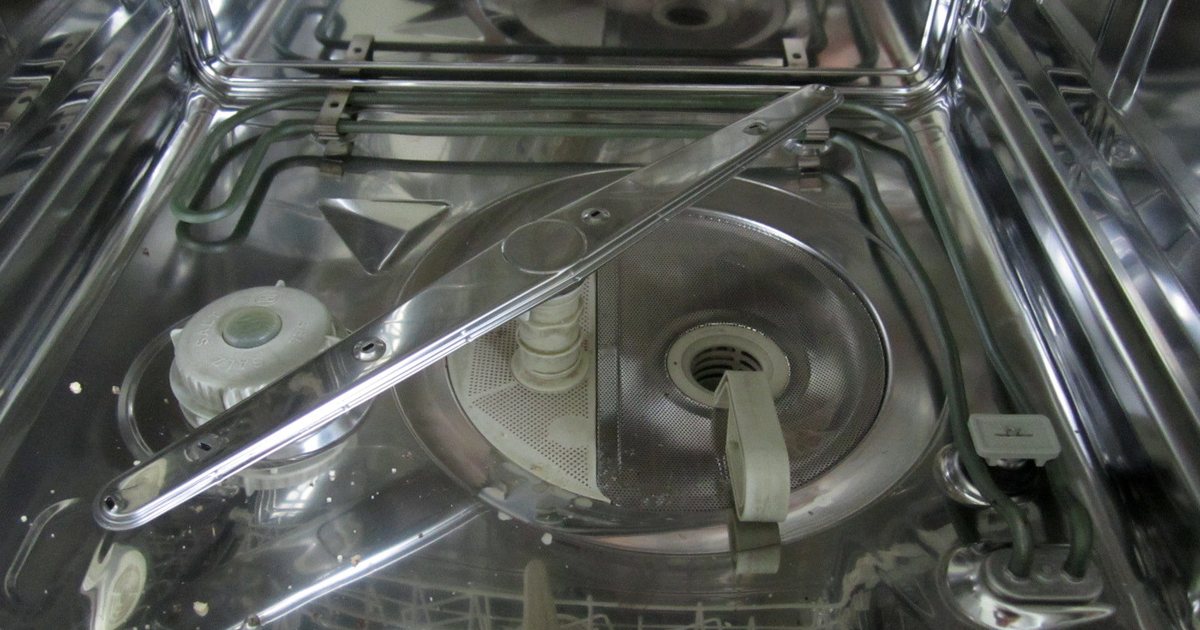
The heating element is the part that warms the wash water and dries the dishes. On many models it's the metal loop around the base of the tub, like the one in the photo above. Look for cracks, blisters or burnt spots first. If there's no visible element, the tech sheet shows where yours sits.
To test it, disconnect the wires from the element's two terminals, usually from underneath the tub, and set your multimeter to ohms. iFixit's guide says a working element "should measure somewhere in the range of 8-30 ohms," and that an infinite reading means it needs replacing.
Check the thermostat and high-limit switch
If the heating element tests fine, move on to the thermostat. It tells the control when the water is hot enough. Many dishwashers also have a high-limit thermostat, a safety switch that cuts the heater if it overheats. If that switch fails, iFixit says the element may not turn on at all.
iFixit says a good thermostat should read near zero ohms. Some models use a temperature sensor instead of a thermostat. Its correct reading is model-specific, so check the tech sheet for the values.
| Part | How to test | Normal reading |
|---|---|---|
| Heating element | Ohms across the two terminals | About 8 to 30 ohms (iFixit) |
| Thermostat | Ohms | Near zero (iFixit) |
| High-limit switch | Continuity | Continuity (iFixit) |
| Temperature sensor | Ohms | Model-specific (tech sheet) |
When the parts test fine: wiring and the control board
If the heating element and thermostat both pass, check the wire connections at each part for looseness or burn marks. After that, the likely problem is the control board or relay that switches power to the heater. The control board is the dishwasher's main circuit board, which runs the cycle and turns each part on and off. Control faults need live voltage testing, so that's a job for a professional dishwasher repair technician.
Heater and control faults can turn up together. On Calgary service calls for a dishwasher that wasn't drying, our technicians replaced the heater, and on some units the control board as well. On Frigidaire FDPC4314 units that stopped mid-cycle with a flashing light, the repair was a set of parts: the main control board and drain pump, plus the circulation pump and heater where those had also failed.
Repair or replace: cost, lifespan and when to get help
Call a professional if you aren't comfortable working near wiring, if the machine shows an error code you can't clear, or if the heating element, thermostat and wiring all test good. Have your model number and your tap water temperature reading handy when you call.
Is it worth fixing a dishwasher heating element?
Usually, if the dishwasher is otherwise in good shape. An exposed loop element is a single part with two wire connections. On models without an exposed element, the heater can be part of a larger assembly, which makes the repair bigger, so check the tech sheet. Our rates page suggests repairing an appliance when it's under about 8 to 10 years old and the repair costs less than half the price of a new unit. A repair is harder to justify on an old dishwasher with other issues, such as leaks, slow draining or a failing control board.
How much does it cost to replace a heating element on a dishwasher?
It depends on the brand and part. Our rates page puts typical dishwasher repairs in Calgary at $180 to $450 before GST, including the $100 diagnostic, parts and labour. That list doesn't name the heating element separately, and rare parts or high-end brands can cost more. The diagnostic is credited toward the repair labour, and you get a firm quote before any work starts.
Our own invoices land in the same range. On customer-paid dishwasher repairs in the Calgary area between November 2025 and October 2026, the median total was about $250 before GST, including the diagnostic. The diagnostic fee was $135 until August 2026 and is $100 now.
What's the average lifespan of a dishwasher?
About 10 years, according to a life expectancy table from the National Association of Home Builders, reproduced in Fannie Mae's 2008 guide Becoming a Landlord. That's an average, and a well-kept dishwasher near that age with one bad part can still be worth repairing.
What if no water goes into the dishwasher at all?
Why is no water going in my dishwasher? That's a fill problem, and the checks are different. KitchenAid's not filling guide says the water supply valve must be on for the dishwasher to fill. Make sure the door is fully latched. On KitchenAid models, a flashing Start/Resume light means the cycle was interrupted: press Start/Resume and close the door within 3 seconds.
Frigidaire also says to check that the water supply line isn't pinched or restricted. If water reaches the dishwasher but it still won't fill, the inlet valve or float switch may be faulty. Our repair services cover testing and fixing both. If you've spotted water on the floor, see our guide to a dishwasher leaking water.
Photo: Geschirrspueler mit Rohrheizkoerper by Cschirp, CC BY-SA 3.0. Cropped.