
Your garbage disposal just stopped working, and now you’re staring at a sink full of standing water wondering what went wrong. This guide walks you through the most common reasons a garbage disposal stops working, how to fix a jam yourself, and when it’s time to call in a professional.
Garbage disposals are one of those kitchen appliances most people ignore completely until the moment they stop working. And when they do stop, it always seems to happen right after dinner, with a full sink and nowhere to put the scraps. At Calgary Appliance Service Pros, we hear this story regularly, and the good news is that most disposal problems have a straightforward fix once you know what you’re looking at.
Calgary homes see a fair bit of use from these units, especially in older neighbourhoods where kitchens were built with disposals as a standard feature. The cold winters also mean people tend to cook more at home for longer stretches, which adds up to heavier wear on kitchen appliances. A little knowledge about how your disposal works goes a long way toward keeping things running through those long indoor seasons.
Key takeaways
- A humming disposal that won’t spin almost always means the flywheel is jammed, and you can usually free it yourself in under five minutes using a 1/4-inch Allen wrench.
- The reset button on the bottom of the unit is the first thing to check if the disposal won’t turn on at all and makes no sound.
- Never put your hand inside the disposal, even when it’s turned off. Use tongs, pliers, or a wooden spoon handle instead.
- Slow draining after the disposal runs is usually a clog in the drain trap or discharge pipe, not the disposal itself.
- Disposals that are more than 10 years old, leak from the body, or trip the breaker repeatedly are strong candidates for replacement rather than repair.
- Running cold water while the unit operates helps prevent grease and fat from solidifying in the drain line.
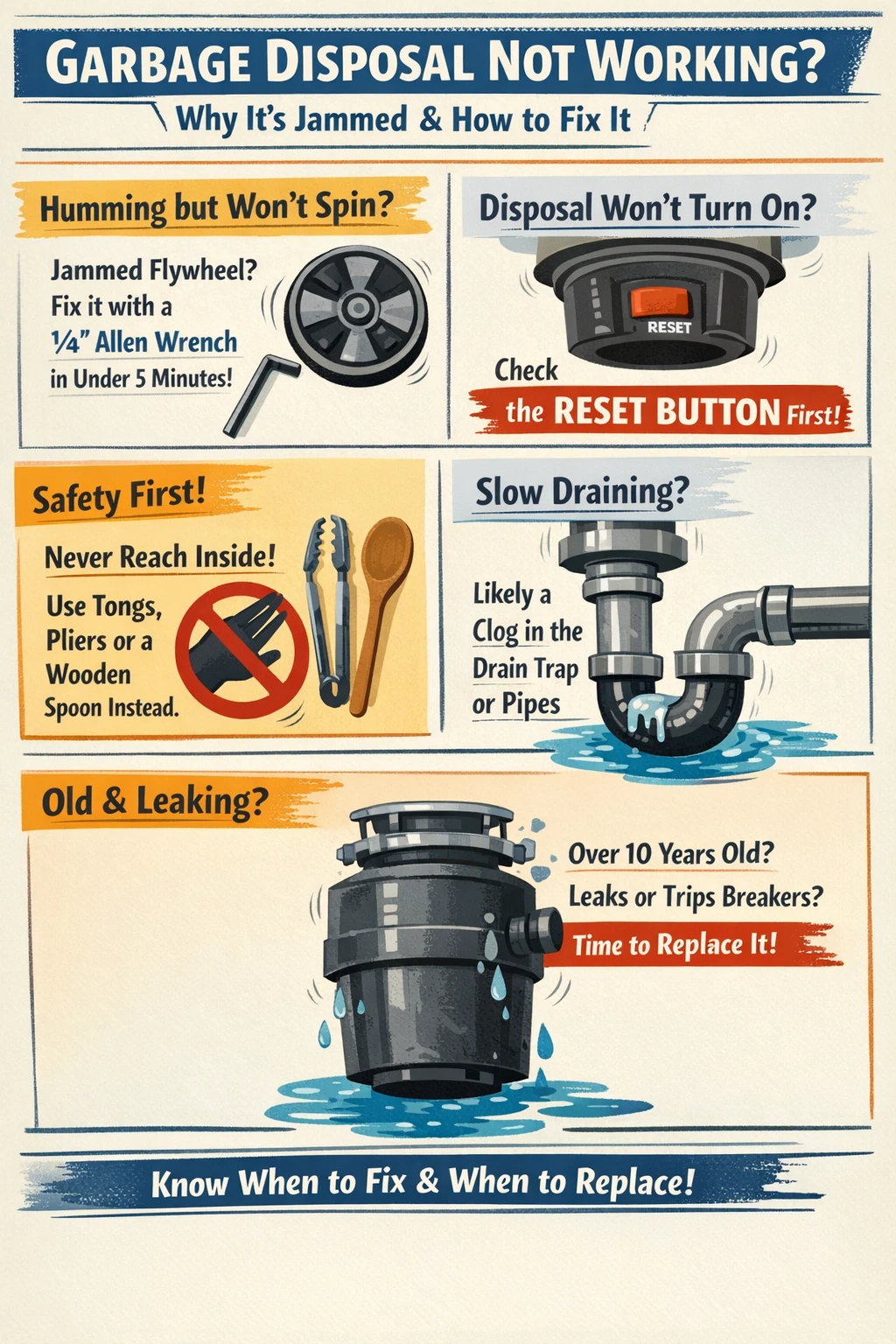
Why your garbage disposal stopped working
The most common reason a garbage disposal stops working is a jam. Something got wedged between the impeller (the spinning plate inside the unit) and the grinding ring, the motor tried to push through it, couldn’t, and the built-in thermal overload tripped to protect itself. You’ll often hear a low hum when this happens, because the motor is receiving power but the mechanism is physically stuck.
The second most common reason is simpler than most people expect: the reset button on the bottom of the unit has popped out. This thermal overload switch protects the motor from burning up. It’s a safety feature, not a defect. If you’ve been running the disposal hard, or something caused a brief jam, the button trips automatically. Press it back in, and you’re often back in business.
After that, the problems branch out into electrical issues, drain clogs, and leaks. We see a mix of all of these in our calls around Calgary, and honestly, the jam is by far the most frequent call we get. It looks scary, but it rarely is.
The disposal hums but won’t spin
This is the jam scenario, and it’s worth going through carefully because it trips people up. When the flywheel is stuck, the motor is running but going nowhere. Left in that state too long, the motor will overheat. Turn the unit off immediately if you hear that hum without any grinding.
Here’s how to free a jammed disposal. First, turn off the wall switch and unplug the unit from the outlet under the sink. Don’t just flip the switch. Actually unplug it. Then look at the bottom center of the disposal unit – you’ll see a small hex socket, usually sized for a 1/4-inch Allen wrench. Most disposals ship with a small offset wrench that fits this socket, and it’s often taped to the unit when you buy it. Insert the wrench and work it back and forth, clockwise and counterclockwise, until the flywheel moves freely. You may feel resistance at first, but keep working at it.
Once the flywheel turns freely, use a flashlight to look down into the drain opening. Tongs or long-handled pliers are your friend here. Fish out whatever caused the jam: a bottle cap, a small spoon, a piece of bone, a fruit pit. We’ve heard stories about shot glasses, measuring spoons, and just about everything else. Once the obstruction is out, plug the unit back in, press the reset button firmly until it clicks, run cold water into the sink, and switch it on. In most cases, that’s all it takes. 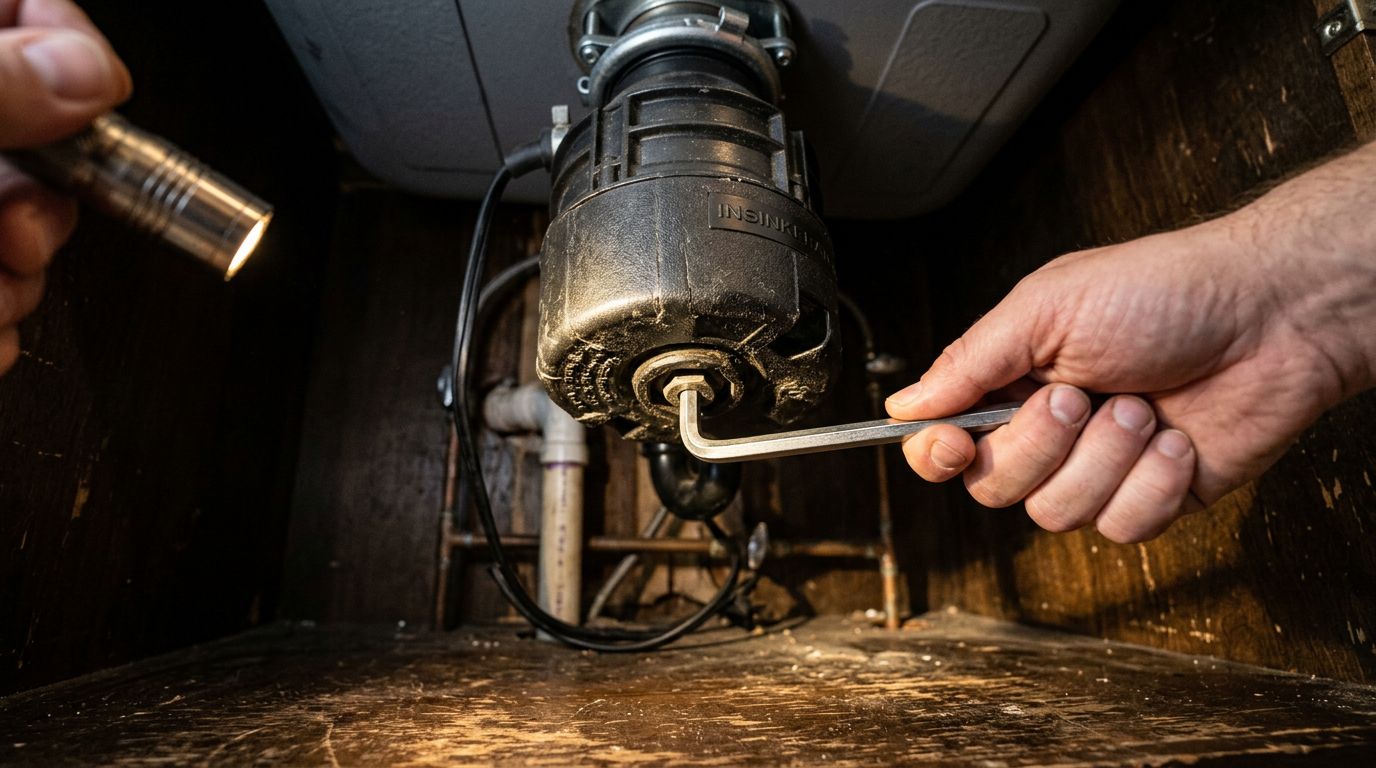
What if you don’t have an Allen wrench?
You can also work the flywheel from above. Take the wooden handle end of a broom or a sturdy wooden spoon and insert it into the drain opening. Use it to push against the impeller blades and rotate them. It’s less precise than the hex wrench method, but it works. Just make sure the unit is unplugged before you stick anything down there.
The disposal won’t turn on at all
No hum, no sound, nothing. Before assuming the motor is dead, run through the checklist. These steps fix the problem more often than you’d think.
Start by checking whether the unit is actually plugged in. Under-sink cabinets get crowded, and it’s easy for the power cord to get knocked loose when you’re storing cleaning supplies or pulling things in and out. If it’s plugged in and nothing happens, check whether the outlet itself is working by plugging in a phone charger or another small appliance.
Some disposals are plugged into a GFCI outlet, which is the type with the small “test” and “reset” buttons built into the outlet face. These outlets trip independently of the main breaker box. If the outlet has tripped, the reset button will be slightly raised. Push it in until it clicks.
If the outlet is fine, go to the disposal itself and press the reset button on the bottom of the unit. It’s a small red or black button, and it should click when you push it. Then try the wall switch again. If that still doesn’t work, head to your home’s main breaker box and check whether the circuit has tripped. A tripped breaker sits between “on” and “off” – flip it fully to off, then back to on. 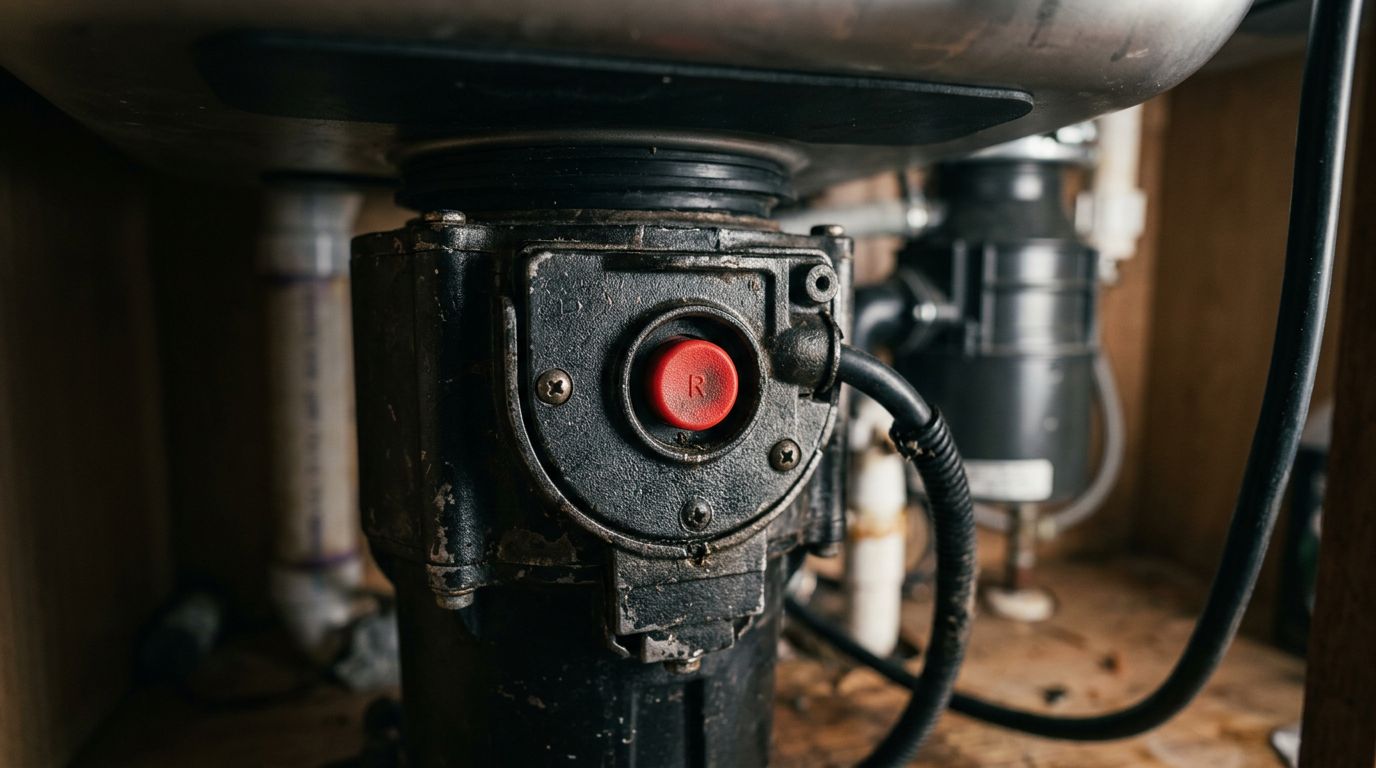
In older homes around neighbourhoods like Bridgeland or Ramsay, where kitchens sometimes share circuits with other appliances, nuisance trips are more common. Worth keeping in mind.
The disposal runs but the sink won’t drain
This one is easy to misdiagnose. The disposal is grinding away, it sounds fine, but the water is pooling in the sink and draining out painfully slowly or not at all. Most people assume something is wrong with the disposal. Usually, the disposal is fine.
The problem is almost always downstream: a clog in the P-trap, the drain trap, or the discharge pipe that connects the disposal to the drain line. Grease builds up in these pipes over time. Coffee grounds, pasta, and rice are particularly good at packing into drain lines and holding tight. Fibrous vegetables like celery or corn husks can also tangle into a mat that water can’t push through.
To check, turn off the power to the disposal and place a bucket under the P-trap, the curved section of pipe under the sink. The P-trap usually has slip-joint nuts you can loosen by hand. Remove it and clear out whatever’s in there. It won’t be pleasant. Rinse the trap, reinstall it, and run some water to see if drainage improves.
If that doesn’t clear it, the clog may be further down the drain line. A drain snake run through the wall connection can usually reach it. If you’re not comfortable doing that yourself, a plumber or appliance service call is the right move. A garbage disposal repair near me search will turn up local help, but make sure whoever you call can walk you through the diagnosis before you agree to any work.
The disposal is leaking
Leaks fall into a few categories, and where the water is coming from tells you a lot about what’s wrong.
A leak at the top, where the disposal meets the sink drain, usually means the sink flange has come loose or the plumber’s putty sealing it has dried out and failed. The fix is to tighten the mounting bolts and reseal the flange with fresh putty. This is a manageable DIY job if you’re comfortable working under the sink.
A leak at the side, where the dishwasher drain hose connects, means that connection has come loose or the clamp has failed. Tighten the clamp or replace it.
A leak from the bottom of the unit is a different story. That typically means the internal seals have failed. On older units, this is usually terminal. The repair cost for internal seal work often approaches the cost of a new unit, so replacement usually makes more sense. The InSinkErator support page has a useful guide to identifying which seal is involved if you want to get specific before deciding.
What not to put in your garbage disposal
This comes up constantly. A lot of disposal problems are preventable, and knowing what the unit can’t handle saves a lot of grief. The disposal is designed to clear small food scraps that end up in the sink while washing dishes. It’s not a compost bin.
The things most likely to cause a jam or a clog: bones, fruit pits, corn cobs, large pieces of any food. Fibrous vegetables, celery in particular, can wrap around the impeller. Pasta, rice, and potato peelings absorb water and expand in the drain line, turning into something that drains about as well as concrete. Grease and cooking oil will solidify in the pipes downstream. Coffee grounds seem harmless but pack into drain lines tightly over time.
What works fine: small scraps that slip through while rinsing dishes, soft food bits, ice cubes (these actually help clean the grinding ring). A few drops of dish soap and cold water run through after use keeps things fresh. The Health Canada home safety resource has broader guidance on kitchen safety if you want context on appliance maintenance generally.
We’ve had calls from homeowners in McKenzie Towne who were putting full peels and vegetable trimmings through the disposal regularly, wondering why it was backing up every few weeks. The unit wasn’t failing. It was just being asked to do more than it was built for.
When to replace instead of repair
Not every disposal problem is worth fixing. At some point, the economics shift, and a new unit is the smarter call.
If the unit is more than ten years old and showing repeated problems, replacement usually beats repair. Same goes if the motor is burning out – a burnt smell, frequent overheating, or a motor that trips the breaker regularly are all signs that the unit is on its way out. A disposal that leaks from the body or housing rather than the connections is also typically done.
Repairs cost more than half the price of a new entry-level unit? Get the new unit. Garbage disposal installation is a manageable project, and newer models run quieter and handle more volume than most units from a decade ago. The Natural Resources Canada energy efficiency guide is worth a look if you’re thinking about what to choose as a replacement.
Frequently asked questions
These questions come up regularly when people are trying to figure out what’s going on with their disposal. We’ve answered each one directly so you can get to the fix as quickly as possible.
Why does my garbage disposal just hum when I turn it on?
A humming sound without any spinning means the flywheel is jammed and the motor can’t turn it. Turn the unit off immediately to avoid burning out the motor. Unplug the disposal, use a 1/4-inch Allen wrench in the hex socket at the bottom of the unit to work the flywheel loose, remove the obstruction with tongs or pliers, press the reset button, and try again.
Where is the reset button on a garbage disposal?
The reset button is on the bottom of the disposal unit, underneath the sink. It’s a small button, usually red or black, that sticks out slightly when it has tripped. Press it firmly until you feel it click back into place. If it won’t stay in, or if it trips again immediately when you run the unit, there’s likely a jam or a motor issue that needs further attention.
Can I put eggshells or coffee grounds in the garbage disposal?
These are two of the most common things people put in that they shouldn’t. Eggshells create a fine, sand-like paste that coats the inside of drain pipes. Coffee grounds pack together in drain lines and build up over time into a stubborn clog. Both are better off in the compost or garbage. The disposal is built for small, incidental food scraps, not regular volumes of either of these materials.
How do I know if my garbage disposal motor is burned out?
A burned-out motor will often produce a burning smell, either during operation or after the unit shuts itself off. The unit may also refuse to start even after you’ve freed any jams and pressed the reset button, or it may start briefly and overheat again within seconds. If the motor is gone, repair is rarely cost-effective. A new unit is typically the better path.
Is garbage disposal repair something I should do myself or call a professional for?
Most jams, reset button issues, and minor drain clogs are reasonable DIY fixes if you’re comfortable working under the sink with the power disconnected. Anything involving the motor, internal seals, or plumbing connections that are leaking or corroded is better handled by a professional. If you’ve worked through the standard troubleshooting steps and the problem persists, that’s a clear sign to make a call.
Wrapping up
Most garbage disposal problems come down to three things: a jammed flywheel, a tripped reset button, or a drain clog that has nothing to do with the disposal itself. Working through those three checks will solve the problem the majority of the time. When it doesn’t, that’s usually a sign of a motor issue or aging seals, and at that point replacement often makes more sense than chasing a repair on a unit that’s past its useful life. If you’d rather not deal with any of this yourself, or if you’ve run through the troubleshooting and still can’t get things working, we’re here. At Calgary Appliance Service Pros, we handle garbage disposal troubleshooting, appliance repair, and a full range of kitchen and home appliance services across Calgary and the surrounding area. Give us a call and we’ll help you figure out the best path forward.
