
Your fridge stopped cooling, and now you’re staring at a warm shelf wondering what went wrong and whether you’re about to spend a fortune on repairs. This guide walks you through the most common reasons a refrigerator stops cooling properly, what you can check yourself today, and when it makes sense to call in a pro.
Calgary winters are brutal, but it’s actually the summer heat that tends to push older refrigerators over the edge. When ambient temperatures climb and your fridge is already working harder than it should, small problems become big ones fast. At Calgary Appliance Service Pros, we see a steady stream of cooling complaints every season, and the good news is that a surprising number of them trace back to causes you can investigate yourself before picking up the phone.
That said, some of these issues do need professional attention. Knowing the difference between a dirty coil and a failing compressor can save you real money, or at least help you have a smarter conversation with whoever you call.
Key takeaways
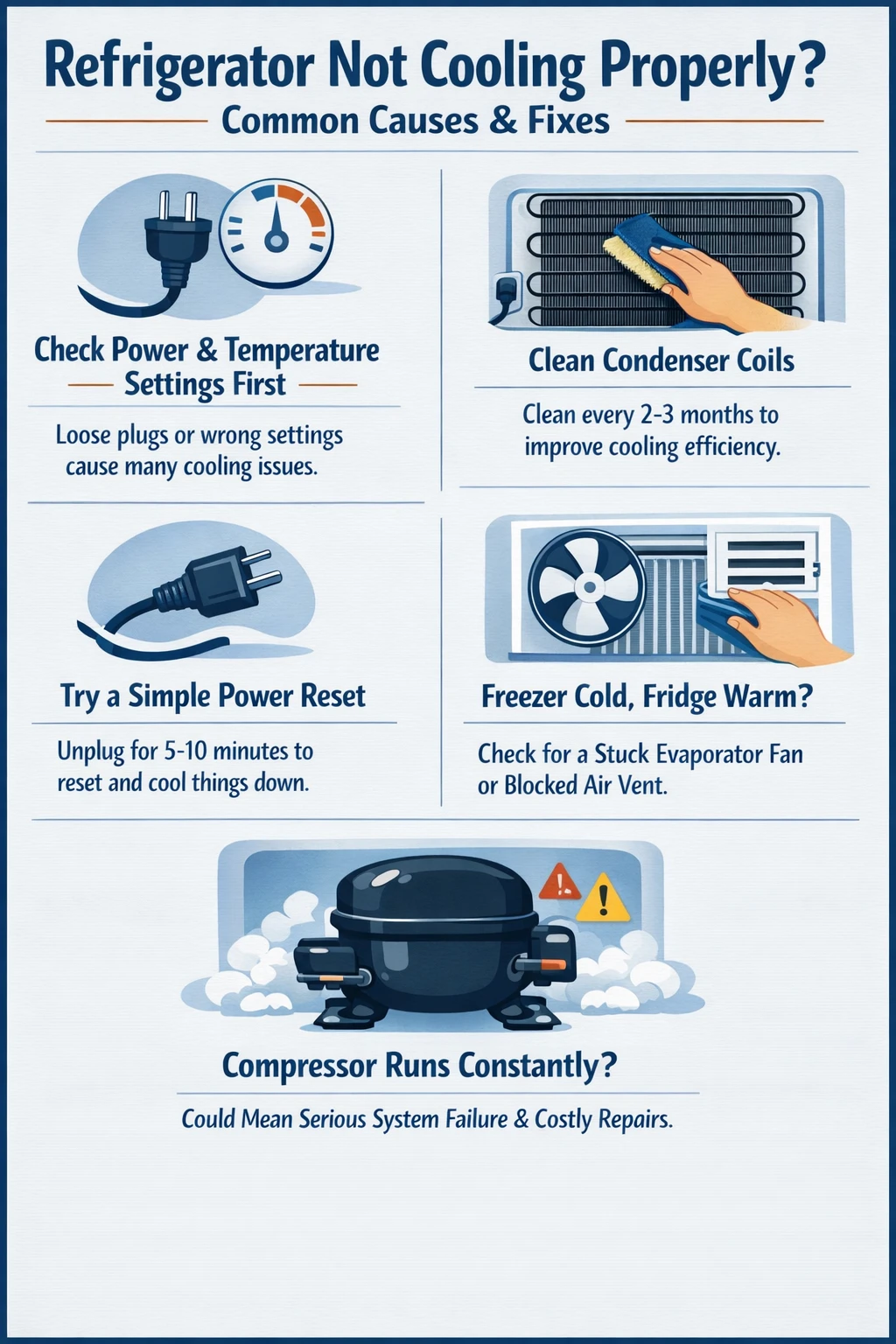
- The ideal refrigerator temperature is between 33°F and 40°F, with 37°F being the sweet spot for most households.
- Dirty condenser coils are one of the most overlooked causes of poor cooling, and cleaning them every two to three months in a dusty or pet-heavy home can prevent the problem entirely.
- A simple power reset, unplugging for five to ten minutes, sometimes resolves temperature issues without any parts or service calls.
- If your freezer works but your fridge is warm, the problem is often a stuck evaporator fan or a blocked air vent, not the compressor.
- A fridge that runs constantly without ever cooling down is a sign the compressor or refrigerant system may be failing, which typically requires professional diagnosis.
- After a reset or repair, give the fridge up to 24 hours to fully stabilize before assuming the fix didn’t work.
Why your refrigerator stopped cooling

Most of the time, a refrigerator not cooling comes down to one of a handful of issues: airflow is blocked somewhere, the defrost system has failed and ice has built up on the evaporator coils, the condenser coils are filthy, or something in the sealed cooling system itself has given out. The first three are things a homeowner can often address. The last one generally needs a technician.
Start with the obvious. Is the fridge plugged in solidly? Has the breaker tripped? It sounds almost too simple, but we see this more than you’d think. One homeowner in an older McKenzie Towne home spent two days convinced her compressor was dying before discovering that something had nudged the plug just enough to break contact. Check the outlet, check the breaker, and make sure the power indicator light is on.
Next, check your temperature settings. The controls on a fridge can get bumped accidentally, especially if you have kids or tend to pack the shelves tight. The refrigerator compartment should be set somewhere between 33°F and 40°F. If it reads higher than that, adjust it and wait a full day before drawing conclusions. Temperature changes don’t happen instantly.
The condenser coil problem most people ignore

If you’ve confirmed the power and settings are fine, the next place to look is the condenser coils. These coils, usually located along the bottom or the back of your fridge, release heat from the cooling process. When they get coated in dust, pet hair, and grease, that heat has nowhere to go, and the compressor starts working overtime trying to compensate.
Cleaning them isn’t complicated. Unplug the fridge, pull it away from the wall, and use a vacuum and a coil brush to clear off whatever has accumulated. In homes with dogs or cats, especially in areas like Douglasdale where newer builds tend to have open-concept layouts that circulate more airborne debris, this can build up faster than you’d expect. Manufacturers generally recommend cleaning every two to three months in those conditions, though once or twice a year is the minimum for most households.
The payoff is real. Clean coils improve airflow, reduce strain on the compressor, and can bring a struggling fridge back to proper performance without spending a dollar on parts. Honestly, this is one of those fixes that looks too simple to be the answer, but it works more often than people want to admit.
Frost buildup and the defrost system
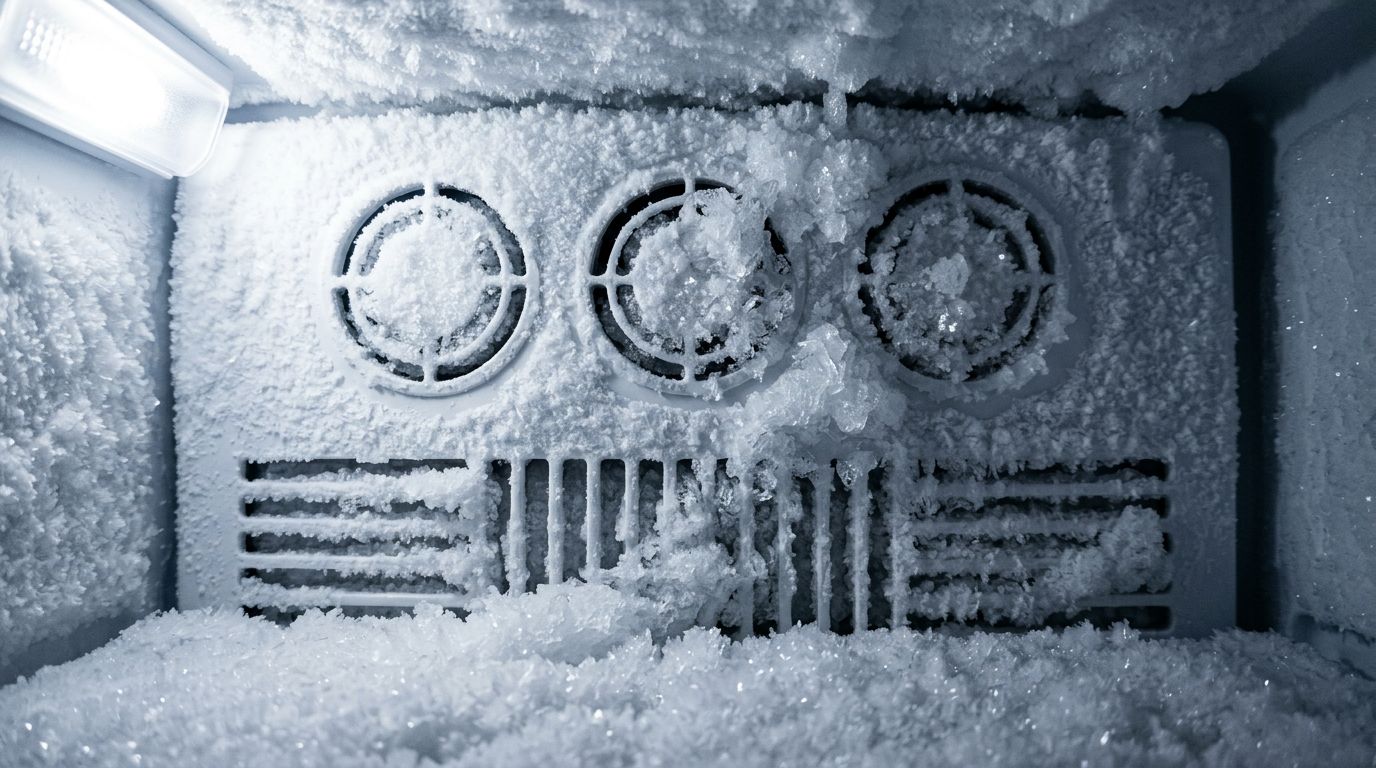
Here’s a situation that trips up a lot of homeowners. The fridge seems like it should be working, the compressor is running, the fans are on, but nothing is getting cold. You open the freezer and find the back wall coated in a thick layer of frost or ice. That ice is the problem.
Modern refrigerators are designed to defrost themselves automatically, roughly four times every 24 hours. When the defrost system fails, whether that’s a bad defrost timer, a faulty defrost thermostat, or a burned-out defrost heater, frost builds up on the evaporator coils hidden behind that back panel. Eventually the frost gets so thick that the evaporator fan can’t pull air across the coils at all. The freezer might stay slightly cool because the coils themselves are icy, but the refrigerator compartment goes warm.
There’s a low-tech way to diagnose this. Remove your perishables, turn the thermostat to off, prop the doors open, and let everything thaw for 24 to 48 hours. Have some towels ready because the drip pan may overflow as things melt. Once it’s fully thawed, turn the fridge back on. If it cools normally for a week or two and then the problem returns, you’ve confirmed a defrost system failure. The fix involves replacing the faulty component, which a technician can typically pin down with a simple diagnostic check.
For more background on how refrigerator defrost cycles work, the U.S. Department of Energy has solid general guidance on refrigerator efficiency and maintenance that’s worth a read.
Door seals, airflow, and the small stuff that adds up
The rubber gasket running around your fridge door is easy to overlook, but a worn or dirty seal can quietly drain cooling efficiency over time. Cold air seeps out, warm air creeps in, and the compressor has to work harder to keep up. Run your hand around the door edge while the fridge is closed. If you feel cold air escaping anywhere, the gasket needs attention.
Start by cleaning it with warm soapy water. Grime and food residue can prevent a good seal even when the gasket itself is still in decent shape. If it’s cracked, stiff, or torn, it needs replacing. That’s a relatively affordable repair, usually worth doing rather than living with the constant energy waste.
Airflow inside the fridge matters too. Overpacking shelves or pushing food right up against the back vents blocks the circulation that keeps everything uniformly cold. This is especially common after a big grocery run. Reorganize so vents are clear, and make sure the fridge isn’t so full that air can’t move freely. While you’re at it, confirm the fridge has at least half an inch of clearance on the sides and an inch at the back. Without that room, heat can’t escape properly from the exterior coils.
One more thing worth checking: make sure the fridge is level. An unlevel installation can prevent doors from sealing correctly and cause all kinds of temperature inconsistencies. Put a level on top of the unit and adjust the feet if needed. Your owner’s manual will walk you through the specifics for your model.
When the freezer works but the fridge doesn’t
This particular combination confuses people, but it actually points toward a pretty specific set of causes. If the freezer is cold and the fridge compartment is warm, the problem usually isn’t the compressor. The compressor is doing its job.
What’s more likely is that cold air isn’t making it from the freezer section into the fridge. In most refrigerators, a single evaporator sits in the freezer, and a fan pushes cold air down into the refrigerator compartment through a damper or vent. If that fan has stopped working, or if the damper is stuck in the closed position, the freezer stays cold and the fridge goes warm.
A faulty thermistor, the sensor that reads the temperature and tells the system when to cool, can also cause this. And in some cases, the main control board needs replacing. That last one tends to be more expensive, so it’s worth having a technician confirm the diagnosis before committing to the repair.
Compressor and refrigerant issues
If you’ve worked through everything above and nothing has improved, the problem may be in the sealed system itself. This means the compressor, the refrigerant, or both.
A compressor that’s running constantly without ever actually cooling the fridge is a bad sign. So is a compressor that starts up, then clicks off almost immediately in a repeating cycle. That clicking pattern often points to a bad start relay, which is a small, inexpensive part that can sometimes be replaced as a DIY repair. Pull the relay off the side of the compressor, shake it near your ear, and if it rattles, it’s likely failed. Replacement relays are available for most common models for under $20.
If the compressor itself has failed, or if the system has lost its refrigerant charge through a leak, those repairs require specialized equipment and training. Refrigerant work in Canada is regulated, and recharging a system without fixing the underlying leak is only a temporary patch. In our experience, compressor replacement on an older fridge often approaches or exceeds the cost of a new appliance, so it’s worth having an honest conversation about repair versus replacement before authorizing that work.
Signs of compressor trouble include a unit that runs non-stop, a compressor that’s extremely hot to the touch, unusual loud noises, or a circuit breaker that keeps tripping. Any of these warrants a call to a professional. For a deeper look at how compressors function, manufacturers like LG and Samsung publish support documentation covering common error codes and diagnostic steps specific to their models.
We handle fridge repair in Calgary regularly, and compressor calls are among the more sobering ones. Sometimes the repair makes sense. Often, on a fridge that’s ten or more years old, the math doesn’t work in favor of fixing it.
Frequently asked questions
After walking through the causes above, a few questions come up consistently. Here are straightforward answers to the ones we hear most often.
How do I reset a refrigerator that stopped cooling?
Unplug the fridge or switch it off at the breaker, wait five to ten minutes, then restore power and set the temperature to between 33°F and 40°F. Give it up to 24 hours to stabilize before deciding whether the reset worked. If there’s heavy frost buildup involved, you’ll need to leave it unplugged with the doors open for a full 24 to 48 hours to clear the ice before restarting.
Why is my fridge warm but my freezer is still cold?
This usually means cold air is being made but isn’t reaching the fridge compartment. The most common causes are a stuck evaporator fan, a closed or stuck damper that controls airflow between the two compartments, or a failed thermistor. Check whether the fan inside the freezer is actually spinning. If it’s not, that’s your likely culprit.
How can I tell if my compressor is failing?
A failing compressor typically runs constantly without cooling the fridge, or starts and stops in rapid cycles with a clicking sound. You might also notice the compressor is unusually hot to the touch, or that your circuit breaker trips repeatedly. Normal compressors make a gentle hum or hiss. Loud rattling or grinding sounds aren’t normal and warrant professional attention.
Is it worth repairing an old refrigerator that stopped cooling?
It depends on what’s wrong and how old the fridge is. Cleaning coils, replacing a door gasket, swapping a start relay, or fixing a defrost component are all reasonable repairs on a fridge of any age. Compressor replacement on a fridge over ten years old is trickier to justify, since the cost often approaches what you’d pay for a basic new unit. Get a clear diagnosis before agreeing to any major repair.
Can dirty condenser coils really stop a fridge from cooling?
Yes, and it happens more than people expect. Condenser coils release the heat your fridge pulls from its interior. When they’re caked in dust and pet hair, that heat stays trapped, the compressor overheats and cycles off early, and the fridge can’t maintain a cold temperature. In homes in areas like Coventry Hills where families with pets are common, coil buildup can happen within a few months. Cleaning them is one of the highest-return maintenance tasks you can do.
The Health Canada home safety resources are also worth checking if you’re concerned about food safety during the period when your fridge is down for repair or defrosting.
Wrapping up
A refrigerator not cooling is annoying, but it’s not always a disaster. Start with the basics, check power, temperature settings, door seals, and airflow, before assuming the worst. Clean those condenser coils if it’s been a while, and if you see heavy frost on the freezer walls, try a manual defrost before calling anyone. These steps resolve a real percentage of cooling complaints without any parts or service bills.
That said, some problems do need a professional set of eyes, especially anything involving the compressor, refrigerant, or control board. If you’ve worked through the basics and your fridge still isn’t right, or if you’d rather not spend your weekend diagnosing it, Calgary Appliance Service Pros handles fridge repair in Calgary and the surrounding area. We also cover washer repair, dryer repair, stove and oven issues, and most other household appliances. Give us a call and we’ll help you figure out what you’re actually dealing with and the most sensible path forward.
